INTERVIEW Innovative local high-tech suppliers will enable Korea to truly lead chip market

Jusung Engineering Chairman Hwang Chul-joo motions during an interview with The Korea Times at the company's R&D Center in Yongin, Gyeonggi Province, Monday. / Korea Times photo by Shim Hyun-chul
Jusung Chairman highlights why components matter in an eco-system
By Kim Bo-eun, Kim Yoo-chul
YONGIN, Gyeonggi Province ― Jusung Engineering Chairman Hwang Chul-joo is considered a legendary figure, as one of the small number of entrepreneurs who founded Korea's first-generation venture companies.
Hwang established Jusung, a manufacturer of semiconductor, flat-panel display and solar cell production equipment, back in 1993. The company became the country's first to export equipment used in the front-end manufacturing process for chips in 1997.
Jusung holds the largest number of patents ― 2,167 ― particularly in the semiconductor equipment industry, and has developed 18 technologies recognized as world firsts.
The company has made it through many ups and downs over the past decades, including losing a major client.
What appears to have kept Jusung going is Hwang's relentless drive. To keep new developments going, 150 billion won ($134.15 million) was invested in building an R&D center on a 26,000-square-meter site in Yongin, Gyeonggi Province, which opened in 2020. The chairman, 62, in hazmat coveralls and Crocs clogs, is ready to enter the R&D center's clean room anytime throughout the day, to check ongoing developments.
At his office in the R&D center, a huge world map covers the wall behind him.
"The map is to remind me how small of a country Korea is, and how small Jusung Engineering is when considering the entire world," Hwang told The Korea Times in an interview at the center in Yongin, April 19. "This keeps it engrained in my mind that technological innovation is the only way for Jusung."
Strong local tech suppliers crucial
Korea is home to the world's two largest memory chip manufacturers ― Samsung Electronics and SK hynix ― that design, manufacture and sell integrated circuit products.
But Hwang said that in order for these players to truly lead the market, they need strong local suppliers for materials, parts and equipment. Various data show that local manufacturers only account for 20 percent of chip-making equipment used in the country.
"Korea's industry grew on infrastructure, personnel and technology developed in Japan, the U.S. and Europe. Much has been achieved since then, but little progress has been made in localizing technology," he said.
"This is because Korea did not make the distinction between imitation and innovation."
However, Japan's trade restrictions imposed in 2019 ― in response to a Supreme Court of Korea's October 30, 2018 decision to order Japanese company Nippon Steel & Sumitomo Metal to compensate four Korean victims of forced labor during the Japanese colonial rule ― came as a blessing in disguise. As diplomatic tensions escalated between the countries, Tokyo made it more difficult to export key chemicals to Korea for the production of semiconductors.
President Moon Jae-in turned this situation into a chance to heighten the competitiveness of homegrown technology, boosting support for local vendors of materials, as well as parts and equipment makers for high-tech products, in order to reduce the reliance on Japanese suppliers.
"It has been a year-and-a-half since the government stepped up its efforts to assist high-tech suppliers. Innovation does not happen in such a short time. It will take five to 10 years to see innovations commercialized," Hwang said.
"But it is meaningful that now, a consensus has been formed that we need to develop our own technology. Now that there is the willingness, and the infrastructure is being laid out, we can expect to see outcomes soon."
The chairman stressed, "A top player relying on foreign suppliers will only be a top player momentarily."
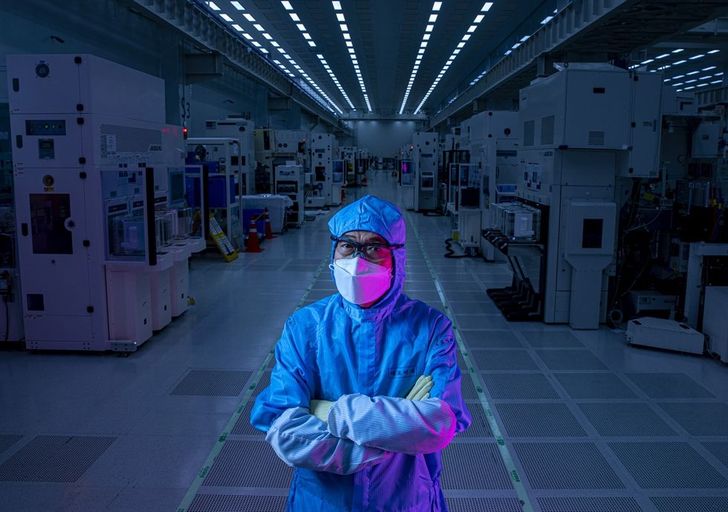
Jusung Engineering Chairman Hwang Chul-joo stands in the company's R&D Center's clean room, where R&D personnel work on upgrading the company's equipment. / Korea Times photo by Shim Hyun-chul
R&D drives Jusung
Having headed Jusung's operations for nearly 30 years, Hwang said that it has all come down to innovation and relations with clients.
"Relations are set up by the entity with more power, but innovation is what can set up good relations with powerful clients," he said.
R&D is what drives Jusung's competitiveness. It underperformed in terms of sales last year, as its clients scaled down investments for semiconductor equipment, but Jusung continued spending on R&D. The firm has invested an accumulated 1 trillion won in R&D since its establishment, and 66.4 percent of its employees work in research as of 2020.
Perhaps due to his own background, Hwang only hires new employees fresh out of college for these positions. As the youngest son of a family with a humble background, he began working after graduating from a technical high school. Later he had the chance to get a college education. Hwang earned recognition as a skilled engineer with his creative pitches and development of technology.
"We don't need highly experienced personnel to achieve innovation. We don't need credentials. As long as they have basic knowledge, willingness and a wholesome spirit, they can achieve growth with us," Hwang said.
As a means of retaining talent, Jusung offers a month-long vacation for staff in R&D positions once they have been with the company for three years.
In the meantime, Jusung has an upbeat forecast for earnings in 2021, based on contracts with major clients signed earlier in the year.
“My goal is for Jusung to become the first company to succeed in producing equipment that enables integrated circuits to be made on materials other than silicon,” Hwang said, stating that R&D is underway to develop such equipment for mass production.