LG Display to expand OLED business
By Kim Bo-eun

LG Display CEO Jeong Ho-young
LG Display reiterated plans Tuesday to focus on organic light-emitting diode (OLED) displays, while restructuring its liquid crystal display (LCD) business to focus on more competitive sectors. The display manufacturer is also seeking to strengthen its plastic OLED (POLED) business for mobile phones.
“LG Display pushed forward with our three core strategic tasks to strengthen business competitiveness and deal swiftly with changes in market demand driven by the coronavirus pandemic-backed, online-centered lifestyle,” CEO Jeong Ho-young said at the company's general shareholders' meeting held in Paju, northwest of Seoul. “As a result, we were able to see significant improvements in earnings and establish a base to normalize operations.”
LG Display posted an operating loss of 29.1 billion won in 2020, but was able to reduce the scale of loss drastically as the company recorded surpluses in the third and fourth quarters. Based on forecasts of increased OLED shipments this year, LG Display is expected to post an annual surplus in 2021.
“This year, we are aiming to achieve complete normalization of management and make a new leap,” the CEO said, adding that the display maker will accelerate its three key strategic tasks to enable this.
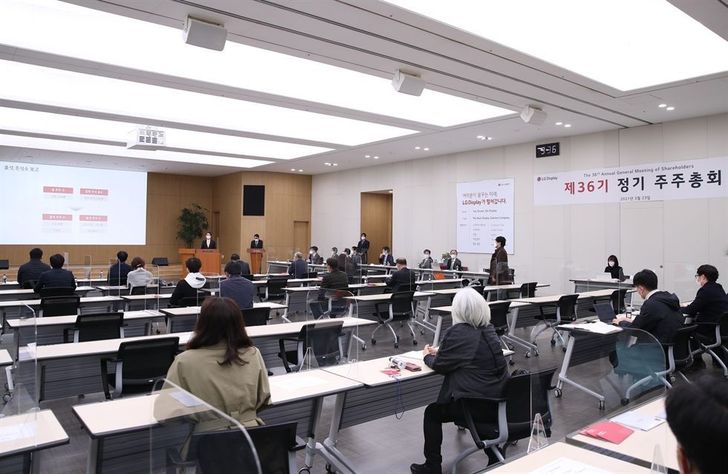
LG Display's general shareholder meeting takes place at its learning center in Paju, northwest of Seoul, Tuesday. / Courtesy of LG Display
Regarding the OLED strategy, the CEO said “Based on a diversified product lineup from ultra to medium-sized and an expanded customer base, we will focus our capabilities on expanding market dominance, strengthening profitability and actively seeking to find new sources of demand beyond TVs.”
OLEDs are considered superior to LCDs given the sharp contrast and accurate color production they offer. LG Display is set to accelerate its business as it completed establishing its production bases for large-scale OLED panels last year. The manufacturer's plant in Guangzhou, China, began mass production in July. The factory is capable of producing up to 60,000 panels a month. Adding this to the production capacity of its Paju plant, this enables 140,000 panels to be manufactured a month. The company meanwhile has expanded its supply to 19 global TV manufacturers.
LG Display is also seeking to strengthen its business in POLEDs for smartphones. For medium-sized and small OLEDs, the manufacturer is focusing on POLEDs, which have an advantage over LCDs because they are lighter and more durable. The company began mass production of POLEDs for smartphones last year, and is set to further enhance its production system this year.
As for LCD panels, the company is seeking to restructure its businesses to focus on more panels for laptops and tablets, which hold more competitiveness. As for TV screens, LG is seeking to boost its competitiveness overseas, while reducing production domestically according to demand.
The CEO also said LG will seek “partnerships with different industries to enable evolution and development of its range and means of business.”
In addition, he pledged to bolster safety at production plants after a toxic chemical leak occurred at LG Display's Paju plant in January. The accident resulted in the death of a worker and injuries for several more.
Based on that case, Jeong said the company “will innovate the safety management system at our plants, with responsibility as the entity in charge of managing and supervising safety.” He also added LG Display would make more efforts in applying environmental, social and corporate governance (ESG) standards to the company.
LG Display introduced a digital voting system this year, to enable shareholders unable to attend the shareholders' meeting to cast their votes online.