INTERVIEW 'Merck continues to cooperate with Korean tech firms'

WooKyu Kim, managing director and representative director of Merck Korea / Courtesy of Merck Korea
By Baek Byung-yeul
The Germany-based science and technology company Merck has reaffirmed its commitment to supporting Korea's high-tech industry with its cutting-edge materials for semiconductors, displays and other electronics, WooKyu Kim, managing director and representative director of Merck Korea, said Wednesday.
“Korea is an important innovation and production hub for Merck. We have made investments in the past to expand our capabilities and we will continue efforts to strengthen the resilience of our local supply chain,” Kim said in an emailed interview.
“We recently opened an Advanced Technology Center in Pyeongtaek to develop next-generation semiconductor materials to support the research and development of chemical mechanical polishing (CMP) slurries and cleans. In addition, we're looking at further developing our capabilities in thin film and patterning in Korea.”
The high-tech materials maker has cooperated closely with Korean companies in the display and semiconductor industries. Merck is especially known for providing highly sophisticated materials for LCDs and OLEDs as well as for every major step in the wafer manufacturing process for computer chips.
Kim was appointed as the first Korean managing director to lead Merck's unit here in October 2020. As the new head of Merck Korea, the managing director said he has been “working on diverse ways to maximize Merck's role in the Korean market” and also help the Korean industry improve its competence further in the high-tech materials, parts and equipment sectors.
“Korea has world-leading semiconductor and display companies, so our strategy is a swift response to the demands of Merck's major customers in Korea to improve customer satisfaction while providing Merck's technological excellence,” Kim said.
“Since Japan imposed trade restrictions against Korea in 2019, Korea has been putting strong efforts into localizing key materials, parts, and equipment for its high-tech industry. Thus, Merck also plans to continue the expansion of production lines that have been underway for the last several years.”
Strengthening communication with the company's headquarters is one of his other priorities as head of the Korean unit, he further noted.
“I will serve to amplify communication between headquarters and companies in Korea and to forge a closer network between Merck and the local market, while contributing to the delivery of our unique electronics technologies and identities to the Korean industry,” he said.
In a bid to cement its leadership in the high-tech materials business, Merck acquired two U.S.-based electronics companies ― Versum and Intermolecular ― in 2019 and changed the name of its Performance Materials division recently to Electronics.
Merck said the Electronics division is involved in every major technology trend including the fifth-generation (5G) network, big data, autonomous driving, artificial intelligence (AI) and the Internet of Things (IoT). Due to these megatrends, the demand for ever smaller, faster and more energy-efficient electronics products continues to grow.
“With the acquisitions of Versum and Intermolecular in 2019, we significantly strengthened our Electronics business sector, aiming to create a leading electronic materials business focusing on the semiconductor and display industries. We expect to benefit from medium- to long-term growth trends in the semiconductor materials market also in Korea,” the managing director said.
Regarding what technology areas Merck expects to cooperate with Korean tech firms on in the future, Kim pointed to the smartphone business using new forms of displays, such as foldable, rollable and transparent screens. He also cited the semiconductor material business.
“First, foldable smartphones are a great opportunity to maximize the benefits of flexible OLED technologies for new products. With the unparalleled performance features of our materials, we have been driving foldable displays by enhancing OLED technology and hard coat solutions that protect and support the flexible properties of this innovative type of display,” he said.
“Second, we are working on breakthrough technologies to meet the demands for miniaturization. A great example is our directed self-assembly (DSA) technology which extends the ability to shrink circuits and produce chips with low cost of ownership. Extreme ultraviolet (EUV) lithography is another enabling technology that further pushes the boundaries of nanomanufacturing.”
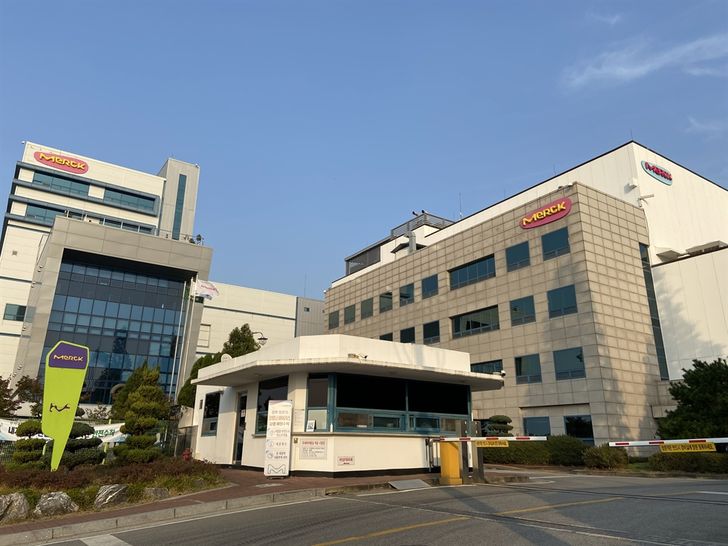
Merck's semiconductor material manufacturing site in Anseong, Gyeonggi Province / Courtesy of Merck Korea
Building on diversity, inclusion momentum
Merck is also actively working on building momentum of diversity and inclusion in an effort to enable all of its employees to demonstrate their abilities and capabilities.
“Merck has committed itself to creating an integrative culture that reflects our values ― courage, achievement, responsibility, respect, integrity and transparency ― and enables all employees to unfold their personal potential. Our objective is to further increase the diversity of our workforce and to offer all employees equal and fair opportunities to develop further,” Kim said.
“The focus of our diversity strategy continues to lie in furthering women in leadership positions. Since Asian markets are becoming increasingly important to us, we have set ourselves a new objective of promoting talent from Asia more strongly. With 2021 having just begun, two influential female leaders at Merck have hit the ground running by sharing their expertise and reflections of monumental shifts in the semiconductor industry at global conferences and I believe this is a good example of Merck efforts and future direction.”