SKT, KT, LGU+ marks 1st anniversary of 5G commercialization

SKT employees gives a thumbs up while installing a 5G base station on top of a building in Seoul. Courtesy of SKT
By Kim Hyun-bin
SK Telecom, KT and LG Uplus (LGU+) have marked their first anniversary of becoming the world's first companies to commercialize fifth-generation (5G) networks. Since April 3, 2019, the telecom companies have evolved the technology to new heights both in the business to consumer (B2C) and business to business (B2B) sectors drastically enhancing user experience as well as laying the infrastructure to make it possible to operate smart factories as well as operations of connected vehicles using 5G technologies.
Now the telecom companies are focusing on solidifying and expanding their coverage while contemplating ways to develop diverse innovative content that could best make use of the technology.
SKT tops 5G subscribers
SKT has been successful in topping the industry with the most 5G subscribers to their network.
According to the Ministry of Science and ICT, SKT led the pact in terms of 5G subscribers with 2.2 million members or 44.7 percent of the market in January, followed by KT with 1.5 million and LGU+ with 1.23 million subscribers.
The country's leading mobile carrier was most popular among people in their 30s and 40s, a combined age group that accounted for 53 percent of the company's total 5G subscribers. The number is significant considering only 32 percent of that age group used the LTE network before the commercialization of the 5G network.
The 5G network average data usage nearly doubled with 28.5GB per person a month, while LTE averaged 14.5GB a month.
The rise in data usage can be attributed to more 5G subscribers utilizing diverse 5G content, such as virtual reality, video streaming and gaming applications, which accounted for 7 times, 3.6 times, 2.7 times increase respectively compare to that of an average LTE user.
To better adapt to the growing demand SKT has set up ”5G clusters” in 70 locations around metropolitan areas but plans to increase the number by three fold to 240 locations this year to provide better coverage.
The company also found success in the B2B market becoming the first telecom company to partner with MS and Amazon Web Service to enhance its cloud services. It also secured large global projects with ATSC3.0 broadcast and other mass communication companies. SKT also passed down its 5G network know-hows to major telecom companies worldwide including Deutsche Telecom, Taiwan Mobile as well as IT&E.
SKT was the first to launch cloud gaming in the world as well as devices that uses Quantum Cryptography. In the BSB sector, the company established 12 5G mobile edge computing (MEC) footholds around the nation to better their coverage and in cooperation with MS and AWS it plans to become the first to release “5G edge cloud.”
When the 5G edge cloud is commercialized, it will be able to connect scores of devices remotely and make possible for unmanned delivery robots, remote medical treatments with minimal delay and create positive changes in manufacture, distribution, and medical as well as robot industries.
Regarding smart factories, SKT plans to build a private 5G network at SK Hynix's semiconductor production line as well as building the world first 5G smart power plant partnered with Korea Hydro & Nuclear Power Company.
In October, SK Telecom signed a deal with Rakuten Mobile, the fourth-largest telecom company in Japan, becoming the first Korean telecom company to export its 5G technology.
Industry watchers point out that the country's 5G technologies and services have garnered great interest internationally, and said they could provide substantial future growth opportunities.
A 5G network transmits a vast amount of data in real-time and has a shorter frequency-reach between mobile and base stations. It is up to 50 times faster than fourth-generation (4G) networks.
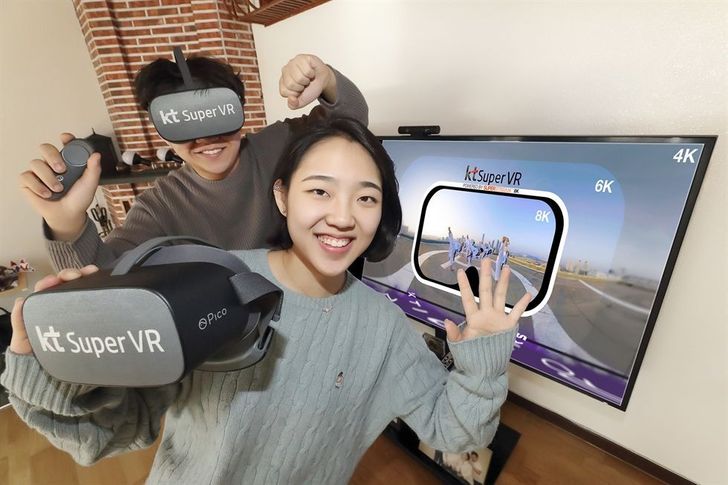
Models tryout the KT Super VR HMDs, the device connected to the 5G network provides 8K VR streaming services. Courtesy of KT
KT to implement 5G in diverse industries
KT has been focused on partnering with major companies to establish private 5G network within the firms, so far 150 B2B networks have been set up last year while an additional 53 clients are set to get on board.
.
As of late, more companies have been reviewing to implement the 5G technology to automate their production line and monitoring system.
KT plans to focus its investments in seven major fields to implement its 5G technologies, which are smart factory, connected car, reality media, tourism, supply chain, disaster management and public safety.
The company says the most notable is the partnership with Hyundai Heavy Industries that was inked in May, currently underway to establish a 5G based smart factory to improve efficiency and safety.
They have been working on projects to combine KT's 5G network, artificial intelligence (AI) and big data technologies with Hyundai Heavy Industries' robotics and shipbuilding expertise, which will allow implementation of voice recognition systems and operate cloud based robot management systems.
According to the company's economy research company the 5G market looks promising capable of racking in 42 trillion won in economic value by 2030. When considering the B2B factor it is predicted to create 115 trillion won in economic effect.
In Pangyo, Gyeonggi Province, the company was the first to operate a 5G connected autonomous bus and in cooperation with Hyundai Mobis have established a 5G connected car and operated a test drive center that implemented real-time navigation update technology called 5G C-V2X.
In collaboration with Samsung Seoul Hospital, KT established the world's first 5G based smart innovative hospital to provide swift and innovative services, which includes digital pathological diagnosis, surgery guidance, established AI “Smart Care Giver” as well as development of autonomous robots.
In the B2C sector, KT launched the 5G video call service “Narle” and 360° reality media service “Real360” which has garnered over 500 thousand and 240 thousand subscribers respectively as well as the 5G streaming games and other communication services.
Real 360 is KT's flagship communication service, allowing customers to video-record and send 360 degree video clips as well as engage in 1-on-1 video calls. The service allows up to four people to be connected simultaneously through a 360-degree video call.
The three major telecom companies, SK Telecom, KT and LGU+, have agreed to invest 4 trillion won in their fifth-generation (5G) networks in the first half of the year in a move to better the coverage.
Approximately 92,000 5G base stations have been installed nationwide as of end of January, which is just 10 percent of the number of LTE base stations.
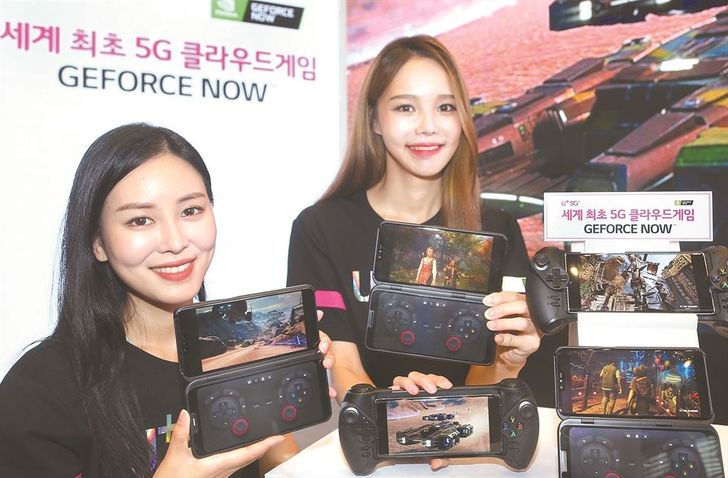
LGU+ models promotes the world's first cloud based game "GEFORCE NOW" which could be played on the company's 5G network. Courtesy of LGU+
LGU+ focuses in 5G exports
For the past year, LGU+ has put an emphasis on developing 5G contents as well as expanding the market.
“For the past year we have focused on developing 5G contents and expanding the market but this year we will focus on exporting our 5G technologies to the world,” the company said.
LGU+ has been focusing and investing heavily in the nine main 5G content fields to enhance their competitiveness in the industry including VR, AR, sports, live streaming and streaming games to enhance customer's 5G experience.
By doing so the total users for the nine key sectors exceeded 22 million creating the basis for popularization and has led to business agreements with major telecom companies in Asia including China Telecom and Hong Kong Telecom to export the AR and VR 5G contents.
The company vowed to invest 2.6 trillion won in the next five years to develop and enhance its diverse 5G contents.
This year LGU+ plans to launch cloud based high quality AR education contents and services as well as VR games using a head mounted display (HMD).
In the B2B field, the company aims to establish 5G based smart manufacture factory as well as 5G autonomous vehicles and smart drones to fuel growth in the industry.
“We have met our first anniversary of commercializing the 5G network amid difficulties the public faces from the COVID-19, but as a telecom company we will do our best to provide good coverage and broadcast services,” a LGU+ official said. “Furthermore we will develop and launch differentiated 5G contents to better the lives of our customer and through exports we will prove the country's superior 5G technologies.”