Can LG find breakthrough in smartphone biz?

Visitors try out LG Electronics' G8X ThinQ smartphone during a launching event in Sao Paulo, Brazil, Nov. 25, 2019. / Courtesy of LG Electronics
Analysts positive on LG's 'different approaches for different regions'
By Baek Byung-yeul
LG Electronics is hoping to end its years-long losing streak in the smartphone business since former CEO Nam Yong's decision to keep the design- and feature-centric phones pipeline full.
The electronics maker lost 1 trillion won ($837 million) last year in the phone market. But the company was still clinging to its dying smartphone business as its chief executive told reporters in this year's Las Vegas tech fair that LG Electronics was hoping for a return to profitability by 2021. The top executive didn't share the specifics on how he plans to resurrect LG's smartphone business.
For LG, which has a wide-ranging portfolio from home appliances and TVs to even automotive electronic parts, the smartphone is considered as one of its important lifelines as mobile-related technologies could be applicable for the development of AI and IoT, connecting different devices with each other.
Also, with many mobile carriers in the world ramping up efforts to launch much faster fifth-generation (5G) networks, LG is waiting for an opportunity to rise up again and regain “the world's third-largest phone maker” title with its 5G-enabled phones.
In 2019, LG moved its phone production line from Korea to Vietnam to decrease fixed costs such as employee salaries. To take on Chinese phone makers, which have released cheap but competitive devices, LG is also expanding outsourcing of production and designing of budget smartphones to China.
This year, the company said it would take a targeting strategy in its marketing approach, selling different packages for each region. In Korea, the company will put forward what it calls a “mass premium” strategy, which is relatively low-priced 5G smartphones compared to high-priced ones.
In contrast with the plan for South Korea, the company will launch premium 5G phones in Europe and North America where consumers are more receptive to high-priced handsets.
So far, industry analysts were pointing out positive aspects of the updated LG strategy saying the series of remedies for turning around the smartphone business will work.
“LG is expected to improve its profit statement by increasing the proportion of outsourced smartphone production. Also its mass premium strategy for the Korean market appears to be effective in terms of cost reduction,” Kim Ji-san, an analyst at Kiwoom Securities said.
They said LG is required to beef up its “different approaches for different regions” marketing strategy, putting more focus on the North and South American markets.
“LG Electronics has seen its smartphone share dwindle in both the global market and the domestic Korean market. Sales declines were seen in the U.S., Brazil and Argentina where the company had previously scored robust sales,” James Kang, an analyst at research firm Euromonitor International Korea, said.
“Given LG has seen a sales increase in Mexico, however, the company needs to concentrate more on the North and South American markets. Also, it needs to strengthen its 'different approaches for different regions' marketing strategy to boost the sales,” the analyst added.
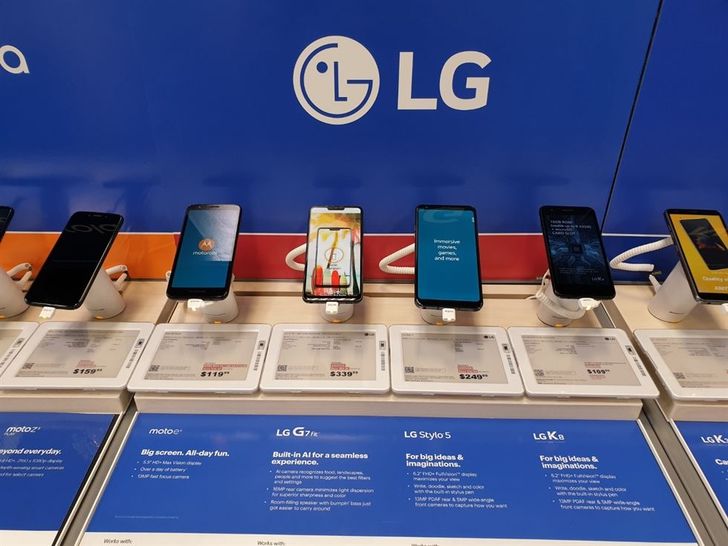
LG Electronics' smartphones are displayed at Best Buy retail store in Las Vegas, Jan. 10. / Korea Times photo by Baek Byung-yeul
Premium 5G phones for North America, Europe
Assessing core factors of its continued dismal performances, LG said, during the conference call with investors in February, its “revenue was down quarter-on-quarter and year-on-year due to the slow sales in overseas markets, with the sales decrease in mass-tier products in the North American region.”
At a time when Apple has not released a 5G version of iPhone yet and Huawei Technologies is also unable to sell devices in the U.S. market, LG was aiming to use the situations as an opportunity to possibly raise its share in the 5G smartphone market in North America as well as Europe.
“This year, premium product demand in developed markets is expected to grow, driven by the actual ramp-up of the 5G market and launch of new form factor smartphones,” the company said during the conference call with investors.
As part of the plan, the company will sell its new premium smartphone V60 ThinQ only in the North American and European markets.
LG estimates the 5G network-enabled phone with a 6.8-inch display and Qualcomm's flagship Snapdragon 865 chipset will be more attractive to consumers there.
Also, the company expects it can save initial marketing costs by launching the V60 ThinQ smartphone because mobile carriers in the regions are expected to be more aggressive in their marketing campaigns to lure more consumers to 5G networks.
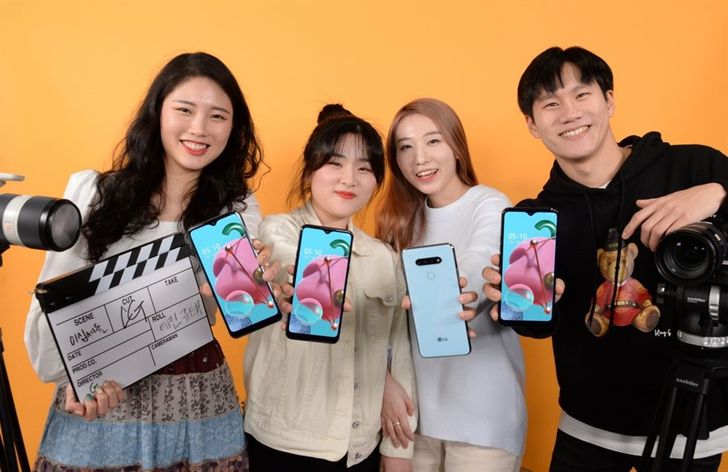
YouTube creator group 20birds pose with LG Electronics' new smartphone Q51, Tuesday. LG said it has collaborated with the famous YouTubers to promote its new device. / Courtesy of LG Electronics
Budget phones for Latin America
LG is also trying to improve its falling presence in the Latin American market with budget smartphones as the company has saw its market share decrease there as seen in other regions.
According to data by market researcher Euromonitor, the firm is estimated to have a market share of 8.6 percent in the region in 2019, down 0.8 percentage points from 9.4 percent in 2018.
LG had the second-largest share there until 2014 with 14.5 percent but lost its seat to competitive Chinese makers while Samsung Electronics still has retained the largest percentage with more than 30 percent market share.
To boost its shares, the company launched new budget smartphones ― the K50s and the K40S ― priced in the $200 range in Central and South America as well as countries in Europe.
It lowered the pricing by using a joint development and design manufacturing (JDM) method, in which the company internally developed software, jointly conducted product design and outsourced the device production.
LG claimed their products are competitive among the budget smartphone brands as the K series are equipped with high-quality displays, cameras, batteries and rugged protection.
COVID-19 may hurt LG's plan
The outbreak of COVID-19 is posing a challenge to LG. Due to the novel coronavirus, the smartphone industry is expected it to have huge impact on handset manufacturing and sales.
Akash Palkhiwala, chief financial officer of U.S. chip maker Qualcomm, on a conference call with investors last month, said the company expects “significant uncertainty around the impact from the coronavirus on handset demand and supply chain.”
LG is already taking the brunt of the virus outbreak as it lost a precious promotion opportunity for its new handsets.
The company was originally scheduled to unveil its high-end smartphone V60 ThinQ in front of the world at the Mobile World Congress (MWC) in Barcelona last month, but withdrew the plan deciding not to join the world's largest mobile fair due to the spread of the virus. Later the organizer of the MWC cancelled the event.
Industry analyst said LG may consider realigning its focus from mass premium market to premium market because it would help the firm minimize possible deficits.
“In a situation when phone makers are struggling with their smartphone manufacturing because of the coronavirus, LG needs to consider shifting its focus to selling premium smartphones in a bid to minimize deficits,” the Euromonitor analyst said.