Companies struggling to find talent for 4th Industrial Revolution
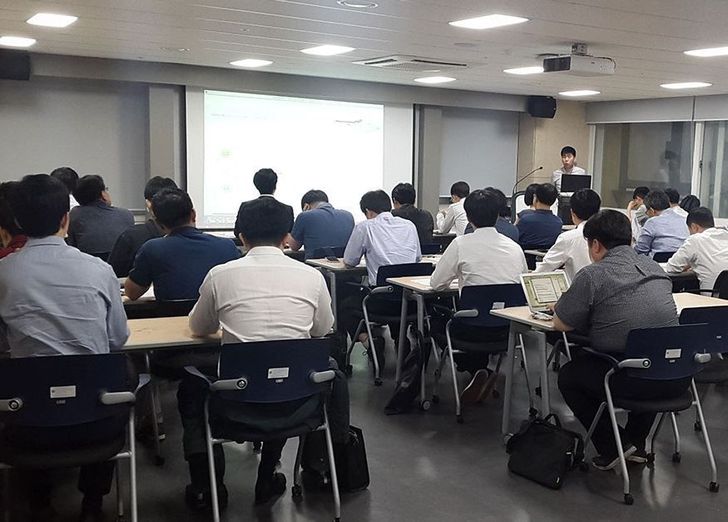
A lecturer gives a data finance lecture at Fininsight private institution in Seoul, June 27. / Courtesy of Fininsight
By Baek Byung-yeul
While more companies look to find new opportunities in the fledging Fourth Industrial Revolution, they are having a difficult time in securing talented individuals in artificial intelligence, big data, internet of things and other rapidly-emerging technologies.
The ongoing talent shortage is widespread across the board, IT industry analysts say, adding that businesses are running their own academies to educate workers or pay startups to do it for them.
Lee, who works at a blockchain startup in Seoul, said the ongoing talent shortage has plagued not only IT startups, but also big corporations such as Naver and Kakao.
“For employees who are skilled with these technologies, they can ask for any salary they want,” Lee said. “As it is difficult to find talented employees, we have to pay way more than big companies.”
According to the Ministry of Science and ICT, Korea's competitiveness in AI technology was only 78.1 percent that of the U.S., last year. This is lower than China with 81.9 percent and Japan with 83.0 percent.
While the industry is required to have about 4,500 talented and knowledgeable workers in the field by 2020, the local institutes who are actively studying this field, such as the Korea Advanced Institute of Science and Technology (KAIST) and the Electronics and Telecommunications Research Institute (ETRI), have only 178 and 87 AI researchers.
To cope with the talent shortage, local companies are acquiring overseas smart tech research labs or operating their own education programs.
Naver, Korea's largest portal operator, acquired Xeros Research Center Europe for about 100 billion won ($89 million) last August. The future tech research institute under U.S.-based Xerox has about 80 AI researchers. The company also jointly established an AI research lab in Hong Kong last April together with the Hong Kong University of Science and Technology. Naver said this is to diversify its employee recruiting route in future technologies.
Fininsight, a local financial data science company, is operating an Insight Campus institution that provides education programs in financial data science, blockchain and AI fields. The official from the company said many companies are letting their employees take these programs.
An expert specializing in AI studies said the government and private companies are taking the right paths to foster people in AI and big data.
“It is inevitable to experience talent shortages in this field because it is emerging. Given only a few professors here have done any studies these fields, it is too much to expect the country to become a leading player right away,” said Lee Kyoung-jun, a professor at the department of social network science at the Kyung Hee University.
Since last year, the Ministry of Science and ICT and the Korea Data Agency have been running an education program for AI and big data study in cooperation with eight universities in the country.
Lee said it is important for companies to encourage their employees to be educated about these emerging technologies.
“I was surprised that the program run by the government is well-designed. For companies, reeducating their employees is very important. It is because their employees are already professionals in their fields. What they are only required to have is updated knowledge and practical techniques in the emerging technologies.
“Our university also received about 80 students who will study big data this summer. What I have been wondering about is the academic backgrounds of those applicants. Most of them graduated from the country's top universities but they applied for the program to go deeper in this field,” Lee said.