Security high on SKT's 5G agenda
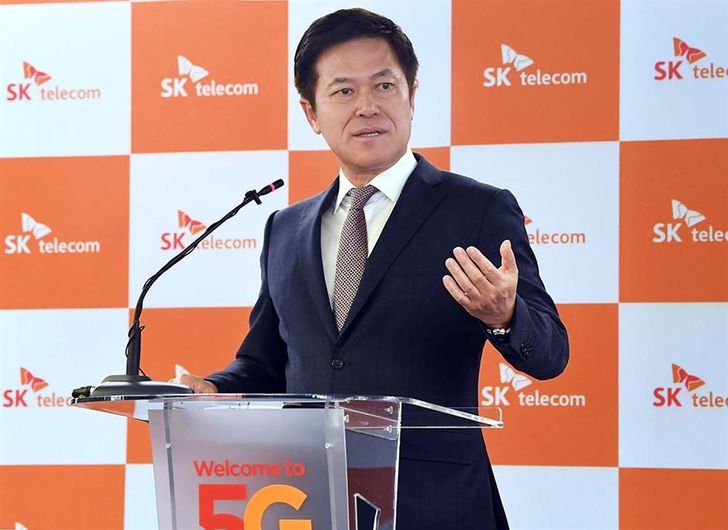
SK Telecom CEO Park Jung-ho speaks during a press conference at a hotel in Barcelona, Spain, Monday. / Courtesy of SK Telecom
By Kang Seung-woo
BARCELONA, Spain -- SK Telecom chief stressed the importance of mobile communications, Monday, in its drive for the commercialization of fifth-generation (5G) wireless technology.
“Amid growing expectations that 5G will control the offline world, the priority that we should place on the technology will be safety,” CEO Park Jung-ho said in a press conference on the sidelines of the Mobile World Congress (MWC) in Spain.
The world’s largest mobile tech show started earlier in the day and Korea’s largest wireless provider is participating in the event for the ninth straight year, setting up its own exhibition zone.
“I do not believe every network operator could offer 5G as some of them would not be able to provide a safe 5G network in terms of security,” he said.
The 5G network, regarded as a next-generation technology, is forecast to enable data transmission speeds 100 times faster than current networks amid expectations it will generate a major economic impact.
The chief also urged the government to play a role in ensuring network security in the coming 5G era.
“So far, the government has mainly focused on speech quality of mobile operators, but now it needs to pay attention to network security,” he said.
Park also hinted that his telecom company is fully prepared to provide such a safe technology.
“I met the Deutsche Telecom CEO this morning and he expressed his hopes of joining forces with us in the development of quantum cryptography even though Germany is an aggressive investor in the sector,” he said.
Quantum cryptography has emerged as essential in encrypting transmitted data using special quantum keys, which are impossible to intercept or steal.
Park’s remarks came hours after SK announced its decision to invest 70 billion won ($65.1 million) in Switzerland’s ID Quantique (IDQ), the world’s No.1 quantum-safe cryptography solutions provider, which will further reinforce SK’s position in the field of quantum-safe communications.
Established in 2001, IDQ launched the world’s first Quantum Random Number Generator in 2002 and the world’s first commercial Quantum Key Distribution (QKD) systems in 2006. The latter is a core technology of quantum cryptography communications that generates quantum keys that can be shared safely between two communicating users.
“In the 5G era where everything in the real world is connected wirelessly, the issue of safety will continue to rise,” said Park.
“We will continue our utmost efforts to provide our customers with the world’s safest 5G technology.”
IDQ CEO Gregoire Ribordy said, “Quantum communications technologies will play a significant role in securing our data and communications, both in backbone networks and at the edge, in an era where the quantum computing will render vulnerable much of today’s cryptography.”
According to market research firm Market Research Media, global quantum cryptography communications will grow into a 26.9 trillion won industry by 2025.
The telecom firm is the first Korean company to establish a quantum technology laboratory in 2011.
SK Telecom has continuously invested in the development of quantum cryptography for wireless communications networks. In 2017, the company developed the world’s smallest Quantum Random Number Generator -- a device that constantly generates random numbers that create strong keys that are not biased and cannot be predicted.