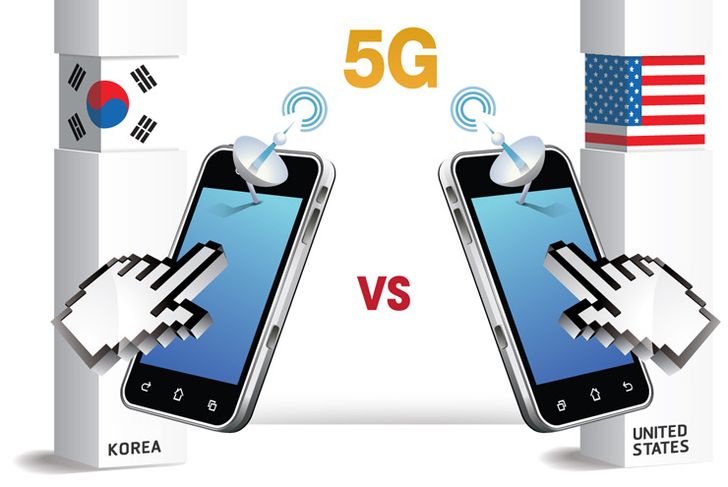
Korea, US compete to lead 5G
By Jun Ji-hye
With local telecom companies seeking to be the world’s first mobile carrier to commercially launch fifth-generation (5G) wireless network service, U.S. giants are rushing to enter the race.
In February, KT Chairman Hwang Chang-gyu announced his company’s goal to commercialize its 5G network by 2019, faster than any other companies worldwide.
Its two domestic competitors _ SK Telecom and LG Uplus _ are also going full throttle to provide their services by the same year as KT.
U.S.-based Verizon recently said it would launch its 5G service in Sacramento, California, by the second half of this year in collaboration with Samsung Electronics, which will be much faster than KT.
AT&T also announced its goal recently to launch its service around the same time.
The 5G network boasts speeds up to 100 times faster than the current LTE networks and allows data transmission speeds 40 to 50 times faster than the current generation.
The key requirement for the 5G technology is it must back 1 million connected devices per square kilometer. Also the total download capacity for a single 5G mobile phone must be at least 20Gbps, according to a draft report published in February by the International Telecommunication Union (ITU).
Officials from the telecom companies here said the conditions for the commercialization of 5G would include the construction of a wireless network infrastructure and the release of mobile phones that can work on 5G.
“Who will unveil a 5G mobile phone and begin the service first will be the key,” a telecom company official said, asking not to be named.
“Once flat-rate payment systems for 5G mobile services are created, and customers actually use them, we can say the 5G era has begun.”
He added the range of areas in which customers can use 5G services would be another important factor.
An official from a manufacturer of mobile devices here said he cannot say for sure the timeline for the development of a 5G smartphone as the 5G New Radio (NR) standardization has yet to be finalized.
But it is generally expected such smartphones would be released by 2019, given the standalone (SA) version is due for completion in June as part of the 3GPP Release 15.
In December, members of the 3GPP ratified the Non-Standalone (NSA) 5G NR specification, which laid the foundation for the formation of 5G products.
Global mobile industry leaders announced their support for the acceleration of the 5G NR standardization schedule in Barcelona last February.
In support for telecom companies’ goal of leading the 5G competition, the Ministry of Science and ICT announced late last year it would hold a frequency auction in June 2018, a year earlier than initially planned, aiming to commercialize the network in March 2019.
KT, the official telecommunications partner of the 2018 PyeongChang Winter Olympics, scheduled for Feb. 9 to 25, plans to run a pilot 5G service there for the first time in the world.