Galaxy Note 8 takes center stage at global telecom fair
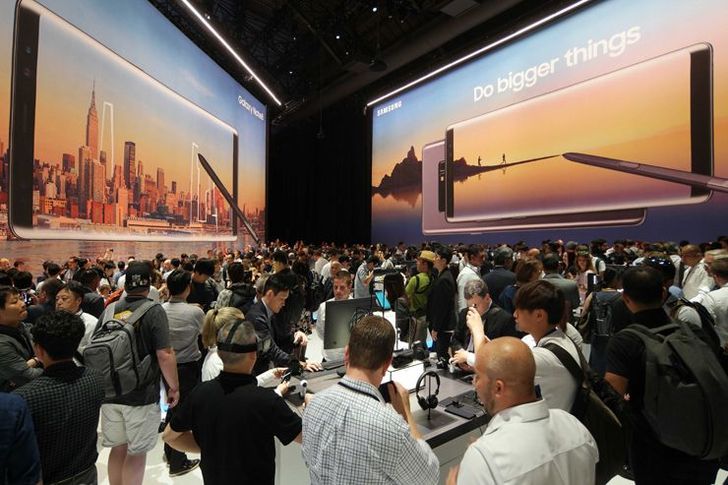
Visitors to the Samsung Galaxy Note 8 Unpacked event take a look at the 6.3-inch premium smartphone at New York’s Park Avenue Armory on Aug. 23. / Courtesy of Samsung Electronics
By Lee Min-hyung
BUSAN — Samsung Electronics’ flagship Galaxy Note 8 is expected to take the limelight as the most sought-after mobile device at this year’s global telecom fair.
The International Telecommunication Union (ITU) Telecom World kicked off Monday with much fanfare in Busan. For this year’s four-day event, the Korean tech titan plans to showcase its latest portable devices and systems encompassing consumer-oriented mobile gadgets and business-to-business (B2B) telecom devices such as network equipment.
Samsung is one of the world’s few tech giants, boasting full-scale high-tech products both for corporate clients and individual consumers. For example, the Seoul-based company is well-known for its leadership in the global memory chip industry used not just for mobile devices, but also telecom equipment.
The 6.3-inch jumbo smartphone, unveiled last month in New York, is the talk of the nation’s mobile business, setting record pre-orders of 850,000 in eight days this month. This is more than double its predecessor, the Note 7, for which pre-orders reached 380,000 in two weeks last year.
The company aims to demonstrate its competitive edge in the mobile industry through the global gathering of influential clients and business leaders here.
“Samsung plans to go all-out to promote a variety of the Note 8’s key functions at the event,” a Samsung Electronics official said. They include its upgraded S pen, which features the much-hyped Live Message feature. This allows users to send animated live messages in their own handwriting using the S pen.
On top of that, the device offers “screen-off memo,” enabling users to take or revise notes simply by popping out the S pen while the screen is off. The Note 8 can save up to 100 memos.
The S pen uses electromagnetic fields for its operation. Starting with the debut of the first Galaxy Note in 2011, the company has teamed up with Tokyo-based digital pen company Wacom to develop the iconic mobile stylus.
The company hypes up the Note 8’s smarter translation services, which can recognize and translate 71 languages.
When users touch a Note 8 screen with the S pen, the smartphone translates a certain sentence of a target language into another. This is a huge leap forward in the global translation industry, overcoming major setbacks from the conventional statistical machine translation technology that can only recognize phrases, not sentences.
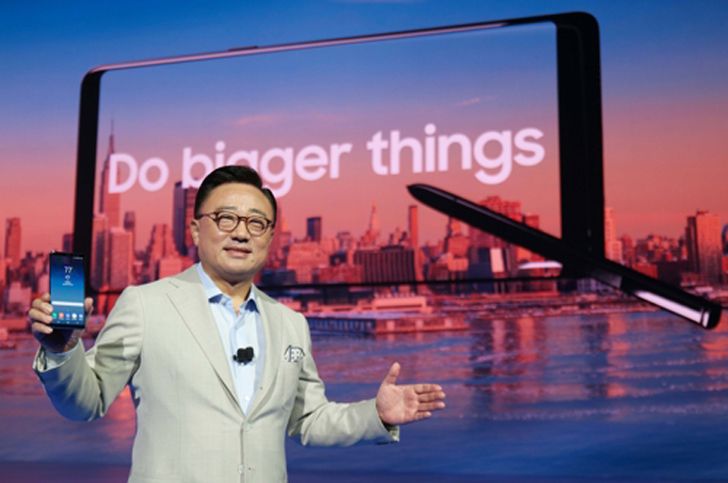
Koh Dong-jin, president of Samsung Electronics’ mobile unit, poses with the Galaxy Note 8 smartphone at its launch event last month in New York. / Courtesy of Samsung Electronics
Top-notch Android security
Samsung also boasts the top-notch security levels of the Note 8, equipped with what the company calls “most secure” smartphone locking system. It is represented by the iris scanner first introduced for its predecessor, the Note 7, last year.
In particular, the company boasts the infrared light-emitting diode (LED) of the Note 8, as it can recognize a user’s iris regardless of the surroundings.
Samsung is pushing for the iris scanning locking system as the next security paradigm for smartphones, as each person’s iris pattern is different, and it never changes over a person’s entire lifetime.
Iris scanning has yet to become standard for smartphones here or abroad. But the company aims to expand its ecosystem to interconnect the platform with a series of the firm’s mobile platforms such as Samsung Pay and Samsung Pass. The latter refers to the firm’s biometric security software used as a substitute for a public security certificate.
These features come as part of Samsung’s efforts to make up for the relatively weaker security presence of Android handsets, compared to Apple's iOS. The Note 8 can also use facial recognition to unlock the device.
“Biometric recognition technology, in itself, does not represent our security efforts. But it is are expected to play a critical role in raising Samsung’s global profile, not just as the world’s biggest Android handset vendor, but the most secure Android player around the globe,” the official said.