AIIB Samsung rolls out high-tech products in India

Officials from Samsung Electronics and the Indian government, including Samsung's IT and mobile communications CEO Shin Jong-kyun, fifth from left, Samsung Southwest Asia CEO Hong Hyun-chil, to his right, and Information Technology and Law Minister Ravi Shankar Prasad, on Shin's left, pose during a groundbreaking ceremony in Noida, India, Wednesday, to expand the tech firm's manufacturing plant. / Courtesy of Samsung Electronics
Tech giant comes up with innovations in South Asian country
By Kang Seung-woo
The Indian government’s “Make in India” policy is aimed at encouraging global companies to produce their products in the South Asian country as part of its efforts to create jobs there.
Samsung Electronics has gone one step further in the growing country in its own “Make for India” initiative with a view to become a bona fide local business rather than just remaining a foreign investor. The initiative is designed to create meaningful local innovations for Indian consumers.
Since its entry into the Indian market in 1995, the global tech giant has made efforts to establish itself as a truly national brand by running two factories, three research and development (R&D) centers, and a design center to build the largest sales and service network of any company in the country.
Plus, Samsung plans to invest 860 billion won ($763 million) there to expand its production of smartphones, which will double its capacity to 10 million handsets a month. Its monthly production of refrigerators is also set to jump to 200,000.
Galaxy S8, Samsung Pay, Z4
Living up to its billing as the No.1 smartphone vender in India, Samsung has come up with innovations related to mobile phones.
On May 5, Samsung launched its latest flagship smartphone, the Galaxy S8 and S8 Plus, hoping the high-end devices would help the Seoul-based company maintain its lead in India, the world’s second-largest smartphone market and also the fastest-growing one.
According to Counterpoint Research, the market share of Samsung smartphones in India stood at 26 percent in the first quarter of the year. The Korean player was also the No. 1 premium smartphone vendor there with a 48 percent market share over the same period.
Samsung is expected to remain the top selling smartphone brand in the coming quarters thanks to the popularity of its new handsets, according to global industry trackers.
Cutting-edge technologies such as the Bixby voice assistant and three biometric-based log-in options are drawing rave reviews from Indian consumers, as evidenced by massive preorders of 80,000 within a week of introduction.
Plus, Samsung offered its Samsung Pay mobile payment service in India from March to provide differentiated services.
For the service, Samsung signed partnerships with Axis Bank, HDFC Bank and Standard Chartered Bank, and payment gateways Visa and MasterCard.
In addition, considering Indian consumers’ needs, Samsung allows the consumers to link their Paytm accounts and let them pay by scanning the QR codes or by using a one-time password. It also offers peer-to-peer (P2P) transfers of funds between bank accounts. Paytm is an Indian mobile-payments app.
In the future, Samsung plans to integrate the government’s unified payments interface on its platform for P2P transfer of money.
“This is a unique innovation. I think it will simplify matters. It will help India technologically leapfrog, and take India toward the digital economy, which is what Prime Minister Narendra Modi’s dream is all about,” said Amitabh Kant, CEO of Niti Aayog, or the National Institution for Transforming India, in March.
Last month, Samsung also introduced the Z4, a Tizen-powered 4G smartphone that provides localized solutions. Tizen is Samsung’s own operating system.
The Z4 is equipped with Smart Glow, an LED notification ring bordering the lens of the smartphone’s rear-facing camera.
According to Samsung, its ring flash will indicate battery status, missed calls, and other notifications it believes are suitable for party-loving young Indians and it can also address the growing consumer need of capturing superior selfies from the rear camera as the flash can give users visual cues through the LED when the camera detects their face.
The gadget also offers the S bike mode that lets consumers ride tension free, while encouraging responsible riding.
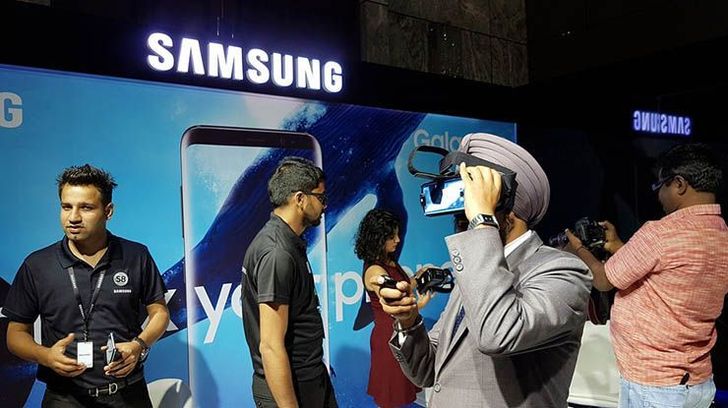
Indian journalists and bloggers try out Samsung's new Gear VR during a launch ceremony in New Delhi, April 19. / Courtesy of Samsung Electronics
Innovative appliances
Committed to improving the lives of consumers through its constant pursuit of ground breaking innovations and value creation, Samsung has been regularly introducing India-inspired innovations.
The company’s global-hit top-load washing machine, the ActivWash, was first released in India in line with the country’s laundry practice ― people hand-wash and soak stained clothes before they go into the washer.
To provide a total laundry solution to Indians, Samsung incorporated a built-in sink just below the machine’s lid and a water jet, which enables them to wash out tough stains with their hands on the washboard without having to travel to the kitchen or the nearest bathroom for a prewash.
Following its success in India, the washer was launched globally, with its sales surpassing 3.5 million.
The Smart Convertible 5-in-1 refrigerator, released on the Indian market in May 2016, offers various storage needs for Indian consumers.
For example, Indians with high vegetable consumption can turn the freezer into a fridge to store more vegetables for longer periods.
In addition, its direct cool single-door refrigerators can operate on home inverters to provide uninterrupted service during power cuts with a cooling retention of nine hours. The fridge automatically adjusts cooling demand during hot weather or frequent opening of the door.
The premium range of direct cool refrigerators comes with clutter-breaking designs for doors and handles that enhance the aesthetics of the refrigerators.
The Samsung Neo Inverter air conditioners were designed for India’s extreme weather conditions, so they can cool quickly, while consuming electricity efficiently.
Next-generation TV
On May 2, Samsung introduced its flagship premium lineup of QLED TVs in India, while showcasing so-called Frame lifestyle TV targeting the nation’s premium TV sector.
Samsung indisputably sits atop the flat TV market with market share of more than 30 percent in the populous country and it is also enjoying more than a 50 percent share in the premium TV market.
The solid displays are mainly thanks to Samsung’s efforts to customize features on its products for Indian consumers.
One of the India-centered devices, among others, is Joy Beat TV.
The product was devised for Indians who prioritize sound in their selection of TVs and it enables people to enjoy a rocking sound with an Integrated Sound Station along with brilliant picture quality.
Another India-only feature is All Care Protection, an enhancement to Samsung’s Triple Protection that guards against damage caused by unstable conditions, such as electricity surges, lightning and humidity.