Kakao tries to catch up with AlphaGo
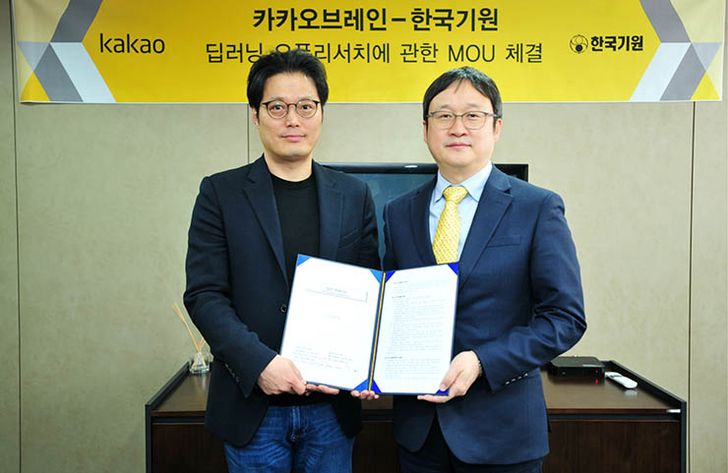
Kakao Brain’s head of artificial intelligence (AI) research Kim Nam-ju, left, poses with Korea Baduk Association Secretary-General Yoo Chang-hyuk at the association’s office in Seoul, after signing an agreement to cooperate for an AI project for researchers and go players, Friday. / Courtesy of Kakao
By Yoon Sung-won
Kakao started developing artificial intelligence (AI)-based go programs under cooperation with the Korea Baduk Assocation (KBA), the tech company said Tuesday.
The move came as part of the company’s aggressive push to develop core AI technologies such as deep-learning algorithms, aiming at introducing the technologies to its existing online and mobile services.
Kakao’s AI technology research subsidiary Kakao Brain and the KBA have signed an agreement on an open research project for developing deep learning technology based on the game of go.
The two will share the results with researchers at home and abroad to develop AI-based go programs. To this end, Kakao Brain will establish an open platform where researchers will freely join to develop technologies through the association’s go game database.
“Though many AI technology researchers are interested in go, the infrastructure for research projects is insufficient as of yet,” Kakao Brain’s AI research head Kim Nam-ju said. “We hope our cooperation with the KBA will vitalize go AI research and development of related programs.”
Kakao and the KBA also expect the research project to help train professional go players and encourage their participation in AI go programs.
“We have decided to cooperate with Kakao Brain as we realized Korea’s go players need changes for the Fourth Industrial Revolution after the showdown between Lee Se-dol and AlphaGo last year,” KBA Secretary General Yoo Chang-hyuk said. “We expect the open platform will bear diverse AI go programs that can be used in actual go training and games.”
Kakao poured in 20 billion won to launch Kakao Brain earlier this year. Kakao founder and Chairman Kim Beom-soo will directly supervise the subsidiary.
The company plans to combine core AI technologies with voice-recognition systems to ultimately use them for its services such as mobile messenger, music streaming, call taxi and navigation.
“An interactive interface such as a chatbot is the core of Kakao,” Kakao CEO Rim Ji-hoon said during a conference call, Thursday.
Rim said the company is planning to release a voice-recognizing digital assistant device in the third quarter. He said the company will be able to play a role in the future when AI technologies will be considered as infrastructure like electricity and water supply chains.
“Imagine our AI technologies connected to our services such as Kakao Talk, MelOn, Daum News, Kakao Taxi and Kakao Navi. I believe Kakao is the best company that can achieve the goal of innovating lives,” Rim said.