Election 2017 Moon widens gap with Ahn in search trends
By Kang Seung-woo
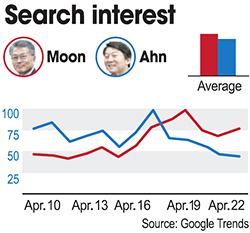
People’s Party presidential candidate Ahn Cheol-soo’s waning popularity is also noticeable on Google as fewer people are searching his name on the search engine.
According to Google Trends, Monday, Ahn’s overall index is at 47, lower than the Democratic Party of Korea candidate Moon Jae-in’s 77. The election is slated for May 9.
Google Trends is a real-time dataset launched in 2006 that shows the search frequency of certain keywords, with 100 as the maximum Google index and zero as the lowest.
It does not show which candidate is doing better in the presidential race, but provides a glimpse of what is on voters’ minds.
Ahn was a laggard in the presidential race until March, but the software mogul-turned-politician surged past Moon in terms of search frequency following his nomination, April 4.
However, since Ahn last outnumbered Moon, April 18 — 87 to 68 — voters have searched the latter more frequently than the former, with the gap becoming 100 against 66 as of April 19.
The drop in his search frequency may pose an additional blow to Ahn whose support rating is falling as the search trends are largely in line with public surveys.
According to the latest five public polls in the past three days, Moon’s lead over Ahn ranged from 9 percentage points to 12 percentage points — a sharp contrast to the early-April polls showing that Ahn was neck and neck with Moon.
In the latest poll conducted by the conservative daily Chosun Ilbo and research firm Kantata Public between April 21 and 22, Moon garnered 37.5 percent, and Ahn 26.4 percent. This compares with an April 7 and 8 survey in which Moon gained 35.7 percent and Ahn 37.5 percent.
Currently, Ahn faces questions about the 2011 employment of his wife as a professor at Seoul National University, with some claiming that she received favors thanks to Ahn’s status.
In addition, Ahn failed to impress voters through the first three TV debates on April 13, 19 and 24 among the top five presidential candidates that also included the Liberty Party Korea’s Hong Joon-pyo, Bareun Party’s Yoo Seong-min and Sim Sang-jung of the Justice Party.
Google Trends made its name after predicting Brexit, or Britain’s withdrawal from the European Union, and the election of President Donald Trump last year.
Back then, the consensus was that the U.K. would vote against Brexit while a majority of experts and media outlets predicted Trump’s defeat against Hilary Clinton.
However, some critics point out that Google Trends is not a perfect tool to replace public polls because search trends data that are irrespective of pros and cons may not have a strong correlation with each candidate’s support rating.
Another hitch in Korea is that Google is not a dominant player here. It is a distant No. 3 search engine following the dominant Naver and runner-up Daum, which prompts suspicions that Google Trends data may not be sufficient to offer relevant search trends.