Telecom operators square off in AI

A model introduces SK Telecom’s voice-recognition digital assistant device NUGU. The company said the device will be updated to be compatible with IBM’s AI service Watson and in the future will be able to understand English. / Courtesy of SK Telecom
By Yoon Sung-won
Telecom companies are expediting their race to create artificial intelligence (AI) businesses by setting up divisions dedicated to them.
SK Telecom recently established an AI business unit directly under the management of its CEO Park Jung-ho. The company said the unit will supervise its AI business applicable to technology development, service planning and business expansion.
The CEO of the nations’ largest mobile telecom company pledged to actively seek change in future businesses.
“The new AI business unit will help us get over the stage of survival, and sustain growth by leading the paradigm in new information and communication technology,” Park said. “We have determined that it is the most urgent task for us to concentrate our capabilities in a certain area.”
The new AI business unit will be headed by SK Planet’s CTO Lee Sang-ho. The research and development division for AI technologies will also be divided into two for better efficiency, the company said.
SK Holdings C&C’s digital transformation President Lee Ho-soo has been appointed as the head of SK Telecom’s information and communication technology unit. Accordingly, collaboration between SK Holdings C&C, which Park used to lead until recently, and the telecom company based on the former’s AI-based enterprise system platform Aibril is also expected to gain momentum.
SK Telecom said it started developing AI-related technologies in 2012. Last September, it released a voice-recognizing digital assistant service called NUGU. It will be updated to be compatible with IBM’s AI service Watson to support English in the future. The telecom company has had more than 70,000 NUGUs downloaded seven months since its release.
The telecom firm said it will also push for peripheral business areas in the AI sector such as autonomous-driving, the internet of things and digital assistant services.
SK Telecom’s archrival KT also strengthened its AI business by establishing a new unit during reorganization in January.
The company has made what it calls the AI Tech Center under its Future Convergence Office. The new unit will focus solely on the research and development of AI technologies as well as strategy planning for AI businesses.
KT’s new AI business unit has been focused on research as it integrates separate departments for features such as voice recognition and analysis. Its goal is to develop a profitable AI business model and launch services soon, it said.
Accordingly, the unit will first push for expanding its services portfolio compatible with its voice-recognition digital assistant GiGA Genie platform and its internet protocol TV (IPTV) service.
Launched this January, GiGA Genie has integrated the conventional voice-recognizing digital assistant with the IPTV platform. Users are provided with both audio and visual information by the digital assistant.
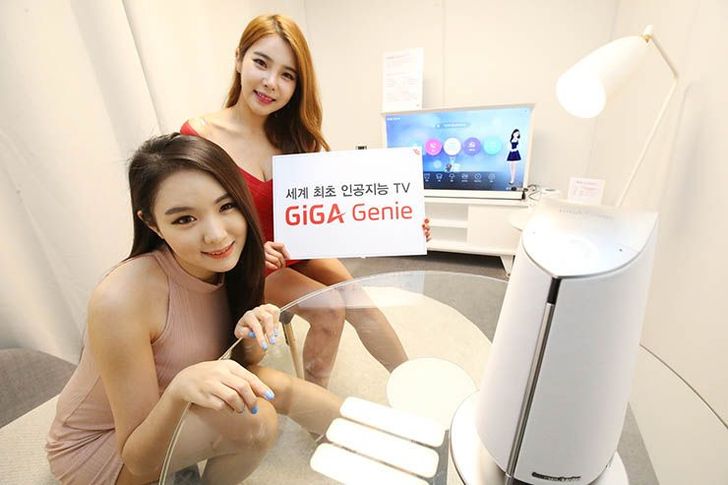
Models promote KT’s voice-recognition digital assistant device GiGA Genie. The telecom company said the device integrates a set-top box for internet protocol television (IPTV) service. / Courtesy of KT
LG Uplus launched its AI services business unit earlier than its two competitors. The unit has some 80 employees in three sectors ― services, platforms and devices.
The nation’s smallest telecom company has yet to release an AI-based digital assistant service. It plans to do so within the first half of this year.
LG Uplus also plans to cooperate with group affiliate LG Electronics in the AI services business. LG Electronics has established partnerships with Google and Amazon these. As the electronics maker has already introduced Amazon’s digital assistant technology Alexa in its home appliances, including refrigerators, it has applied Google Assistant on its flagship G6 smartphone.
An industry source said LG Uplus will need to collaborate with LG Electronics or a third-party partner to secure core AI technology.
“AI services need multifold base technologies such as machine learning and natural language processing. But researching them from scratch will require too much time for LG Uplus to keep up with the pace of competition,” the source said.
Banks adopt intelligent systems
Banks are also pushing to introduce AI-based technologies for sustainable business growth.
One of the examples is the robot adviser (RA) service. Shinhan Bank launched its RA mobile asset management service, dubbed M-Folio, last November.
RA services have been considered to be useful for venture capitalists as their advice is based on investment patterns and solid information, not on expectations of humans.
Woori Bank, KB Kookmin Bank, the Industrial Bank of Korea and NH NongHyup Bank are also gearing up to introduce RA services.
Shinhan has also introduced machine learning big data analysis technology, credit evaluation modeling and financial transaction monitoring systems.
Woori Bank has released a voice-recognizing smart banking service named SORi. Users can give verbal orders to the system. The lender expects that the new banking system will be particularly helpful for elderly customers who are not familiar with smart devices.