SK Telecom calls for more AI investment
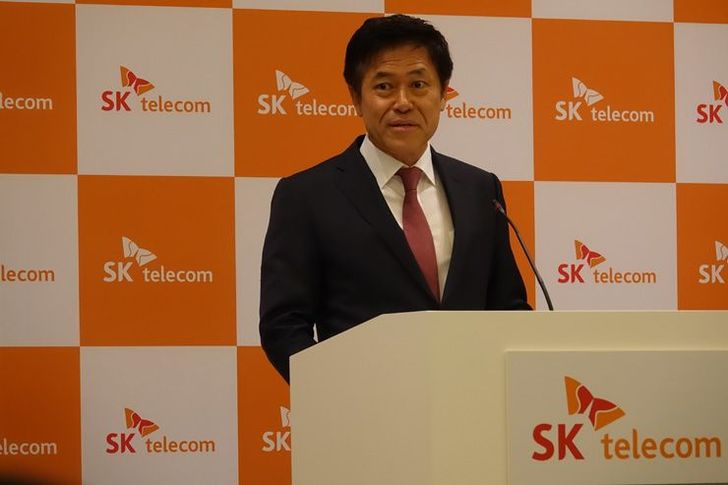
SK Telecom CEO Park Jung-ho talks about the firm’s vision during a press conference at the Fairmont Rey Juan Carlos Hotel in Barcelona, Spain, Tuesday (local time), on the sidelines of this year’s Mobile World Congress (MWC). He underlined media, the internet of things (IoT) and artificial intelligence (AI) as key growth areas. / Korea Times photo by Lee Min-hyung
By Lee Min-hyung
BARCELONA ― SK Telecom CEO Park Jung-ho has called for the need to increase investment in artificial intelligence (AI) as the nation lags far behind major economies in emerging technologies.
“Global portal operators here and abroad view AI as a future platform as it provides specific answers to users by analyzing their data,” he told reporters at a press conference here on Tuesday
“AI is a more customer-centered platform,” he added, on the sidelines of this year’s Mobile World Congress (MWC).
SK Telecom is one of the nation’s few AI players pushing for the AI leadership.
During the four-day mobile tradeshow, the company showcased four AI-converged robots, including a voice recognition assistant, Nugu, and a Social Bot that can communicate with a user’s voice and hand movements.
“Google is paying close attention to the AI platform because the technology is well ahead of existing user interfaces,” he said.
Before Park took the helm as chief of SK Telecom, he had served two years as the CEO of SK C&C, the IT system affiliate of SK Group. While in that position, he imported the AI supercomputer Watson to Korea for the first time.
“With Watson, we need to improve the quality of existing commercial AI services here,” he said. “Korea needs to narrow the technological gap with overseas tech giants. To this end, we need to open AI departments at universities, and secure talent in the area as Eastern European countries are doing.”
He also picked media and the internet of things (IoT) as the firm’s next key growth areas in non-telecom sectors.
With the rise of smartphones and telecom development, fewer people are watching TV. This is especially true for Koreans whose mobile media ecosystem is much more advanced than it is in any other countries, according to Park.
“The mobile media enable advertising when people are watching content,” he said.
“The content, in itself, is commerce, but a new commercial platform can be developed through the consumption of media.”
On Monday, SK Telecom’s video-streaming app, Oksusu, was recognized as the best mobile video service app from the Global System for Mobile Communications Association (GSMA), the MWC organizer.
“We have some 6.9 million Oksusu subscribers. With the platform, the Korean Wave or hallyu content can be exported to China and Southeast Asian countries. The potential success of such a platform service can help globalize Korean content.”
Park also pledged to invest more to establish an IoT ecosystem for growth.
“The IoT can play a role as a potential commercial platform,” he said. “The IoT business is not about chips, but algorithms that can benefit the lives of people.”
5G commercialization
The fifth-generation (5G) network was all the rage at this year’s MWC.
“SK Telecom will join forces with global network equipment manufacturers for our planned 5G commercialization in 2019,” he said.
5G has been the key theme of the mobile tradeshow, as the next network standard will speed up the arrival of other emerging technologies such as AI, connected vehicles and augmented reality.
“We requested Qualcomm to provide us with 5G chips by the end of this year as the 5G standard has not yet been established,” Park said.
The 5G chips will be used to experiment and test driverless cars in areas including Bundang, Gyeonggi Province, according to Park.