Samsung beats market's profit forecasts
By Bahk Eun-ji
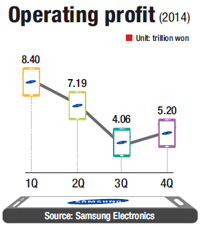
Samsung Electronics estimated its fourth-quarter operating profit at 5.2 trillion won, Thursday, down 37.4 percent from a year earlier, showing that the firm has yet to come up with a new growth engine after its smartphone success.
Its operating profit represents a 28.1 percent rise on a quarterly basis. The exact figures are scheduled to be released later this month.
Quarterly sales were estimated to have fallen 12 percent from a year earlier to 52 trillion won.
The company saw its smartphone segment undercut by fiercer competition from Apple and Chinese rivals.
However, the fourth quarter’s profit was better than market expectations thanks to a stronger performance in the semiconductor segment. The general market consensus was less than 5 trillion won for the fourth quarter.
Samsung stock closed up 7,000 won or 0.54 percent at 1.314 million won, as the benchmark KOSPI closed up 1.11 percent at 1,904.65 points.
Analysts expect the company to post improved results this year, boosted by the better performance of the semiconductor division.
“Its smartphone sales continued to come under pressure. Still, earnings from the semiconductor division have been moving upwards. Sales of memory chips will strengthen further in 2015,” said Lee Se-chul, a tech analyst at NH Investment and Securities.
Lee said Samsung’s smartphone market share is expected to expand in line with the firm strengthening its focus on low- and mid-tier smartphones.
“Likewise, sales will be backed by the release of the company’s new flagship, the Galaxy S6, and the sales of the IT and mobile communications division should pick up from the second quarter in 2015.”
Samsung began selling the budget smartphone models, Galaxy E7 and E5 in India early this week. It also released the Galaxy A5 and A3 last November in China, in hopes of recovering market share.
The semiconductor division is expected to have earned more than the mobile business in the fourth quarter, due to robust demand for memory chips from smartphone and personal computer makers.
At its peak in 2013, the mobile division made around 70 percent of Samsung’s profit. In the third quarter last year, it dropped to about 40 percent mainly due to the release of Apple’s iPhone 6, and a strong trend among Chinese players such as Xiaomi and Huawei.
Samsung’s global share of the smartphone market, which had reached more than 30 percent in 2012, also fell to 23.7 percent in the third quarter last year.
Lee Seung-woo, an analyst at IBK Securities said although the market has not taken the uncertainty out of the mobile division of Samsung yet, it seems the company has passed the low profit point.
“Samsung seems to be stabilizing in 2015 as chip and other divisions are showing signs of improvements,” the analyst said.