Samsung, LG eyes 'smart home' in common, vary in strategy

A model demonstrates Samsung Electronics’ smart home service using a smartphone and a smart television at the company’s booth in CityCube Berlin, a new exhibition venue Samsung has exclusively secured for this year’s IFA fair in Germany. / Courtesy of Samsung Electronics
By Yoon Sung-won

BERLIN ― Samsung Electronics and LG Electronics, the two largest Korean electronics makers, shared the common view on the importance of smart home technology in the global market at this year’s IFA in Berlin and both anticipate building a new ecosystem for it.
At the same time, however, the two electronics giants showed differences in their respective strategies for home appliances and connected home solutions, as well as in their approaches to smartwatches, the most representative products in the wearable smart device market.
Yoon Boo-keun, president of Samsung Electronics’ consumer electronics division, emphasized the importance of the smart home segment, saying “homes will be at the center of future innovation of electronics technology,” in his keynote speech at Europe’s largest technology fair, Thursday.
Jo Seong-jin, president of LG Electronics’ home appliance division, said in a press conference a day earlier, “We have seen a rapid advancement of the smart home technology since 2011 when we first launched the service. That’s why we decided to introduce its update at IFA and launch it in the European market,” underlining the significance of the technology in the company’s blueprint for the future.
Samsung established a large separate corner this year to demonstrate its smart home service and related home appliances at the center of its exhibition hall called “CityCube Berlin.”
The new venue, which the company has exclusively secured under close partnership with IFA for the first time this year, represents its willingness to display its leadership in electronics.
LG released its plan to expand cooperation with its global partners for its smart home service “HomeChat.” The service is designed to allow users to communicate with home appliances such as washing machines, refrigerators and vacuum cleaners to control them.
“The global electronics industry is moving toward the smart home service as we can see from relatively conservative European brands such Miele inclining to join in,” Jo said. “We believe the smart home segment is being fleshed out.”
The two companies are both working to establish an open platform for their smart home service in the belief that it is important to encourage more brands and manufacturers to participate to beef up the establishment of an ecosystem for the service.
Samsung has organized the Open Interconnect Consortium (OIC) with global partners including Intel to settle problems such as interconnection and technology standardization. It also acquired a U.S. open platform developer SmartThings to strengthen its technological capability.
LG made an agreement to cooperate with U.S. indoor temperature control technology developer Nest, which has recently been acquired by Google, while working with the Internet of Things (IoT) platform AllJoyn, allowing the service to support more devices made not only by LG but also by other manufacturers.
The company plans to release the updated service in North America within the year and is talking with Spain’s largest telecom company Telefonica to launch the service in the European market early next year, Jo said.
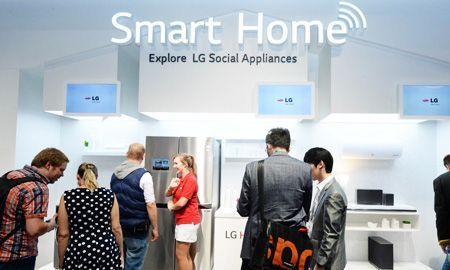
Visitors try out LG Electronics’ smart home service “HomeChat” at the company’s booth in the Messe Berlin exhibition center, the main venue for Europe’s largest electronics fair IFA 2014, Thursday, local time. The company said it will launch and promote the service in global markets including North America and Europe. / Courtesy of LG Electronics
Differences in strategies for home appliances, wearable devices
Samsung is concentrating on prestige products whereas LG puts more emphasis on energy efficiency.
Samsung looks to promote an image as a creative market leader with its bendable and curved televisions and the luxurious kitchen appliances. In its premium lounge, the company introduced four Michelin chefs demonstrating the “Chef Collection” appliances such as a refrigerator, oven and dish washer while cooperating with world-renowned artist Miguel Chevalier to exhibit his work inspired by Samsung’s curved televisions.
On the other hand, LG, which has long been considered as a powerhouse in th home appliance segment, puts more emphasis on product capacity and energy efficiency.
“Efficiency is one of the two main issues in this year’s IFA alongside the smart home,” Jo said.
Meanwhile, a more stark contrast was seen in the two companies’ approaches to smartwatches.
LG showcased the world's first round smartwatch, dubbed the G Watch R, which has a rounded plastic OLED display on a metal body and replaceable leather strap. An LG official explained it designed the new smartwatch as a more watch-like device for more convenient daily use.
On the contrary, Lee Young-hee, executive vice president of Samsung Electronics' mobile business division, said its latest smartwatch “Gear S” is more like a symbol of the company’s challenges in innovation than an immediate cash generator.
“It's more about market leadership and we hope to create a culture of smart devices on a different level rather than simply raising sales volume and market share."
Follow Yoon Sung-won on Twitter @pieche