Samsung aims to set standard in appliances
CEO urges more cooperation for new business opportunities
By Yoon Sung-won
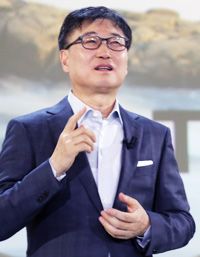
Samsung co-CEO Yoon Boo-keun
BERLIN ― Samsung Electronics, the world's largest technology company, in terms of revenue, aims to change the home lifestyle industry. The company claims that connected appliances could be the next huge thing in technology, while also becoming its next big source of revenue.
Samsung's co-CEO Yoon Boo-keun, who is also the chief of its consumer electronics division, Friday vowed that this technology will play a key role in realizing the “future home” and urged more cooperation among interested parties.
“In the future, homes should adapt to their owners, as this technology will be able to display information about owners’ households and recommend suggestions to further improve their living quarters,” Yoon said in his keynote speech at this year’s IFA, Europe’s most influential electronics fair held every year in Berlin, Germany.
“Companies should grasp customers’ needs and cater to their individual needs and different lifestyles. Technology is a powerful way in meeting their needs.”
Yoon also talked about how people will become the new center of technological innovation.
“Humans, not technology, will be the subject of change in the days to come,” he said. “Whereas the alteration of people’s lifestyles has been brought on by new technologies in the past, the future will be designed in catering to people’s needs and technology will be developed to assist in this endeavor."
Samsung is heavily pushing to grow its appliances business led by CEO Yoon, who significantly helped the firm become the global top TV manufacturer since 2004, amid a steep fall in profits in its crucial handset division.
The company earlier defined the three values of future homes. The firm said they should be “protective” against external harm, “flexible” to meet the various wants of people and “responsive” to human inquiries.
During the speech, the top Samsung executive said the level of consumers’ expectations will vary by both region and individual families, triggering the future home to be transformable in meeting the billions of lifestyle preferences.
This means future homes will autonomously analyze data collected by appliances, learn people’s lifestyle patterns, and offer a solution based on their daily living habits, according to his observation.
Samsung Electronics has looked for insights about consumers through lifestyle research labs, product innovation teams and design centers around the world. It consulted 34 experts including anthropologists and nursery facility managers and surveyed about 30,000 customers in 24 countries to set a more accurate view for future homes, Yoon said.
He also emphasized the company plans to further cooperate with partners to establish an open source platform and set a global standard for more compatibility and consumer convenience.
For this, Samsung has organized the Open Interconnect Consortium (OIC) with industry leaders such as U.S.-based chip giant Intel to discuss interconnection, technology standardization and open source development.
During keynote speeches, Professor Kent Larson of the Massachusetts Institute of Technology, as well as Alex Hawkinson, CEO of U.S. open platform developer SmartThings, joined Yoon to share the vision for the future of the home. Samsung Electronics acquired SmartThings last month to strengthen its capability in the smart home sector.
Yoon added connected home appliances will raise the bar for the global electronics industry, create more job opportunities and start a ripple effect in societies around the world.