World's oldest sperm found
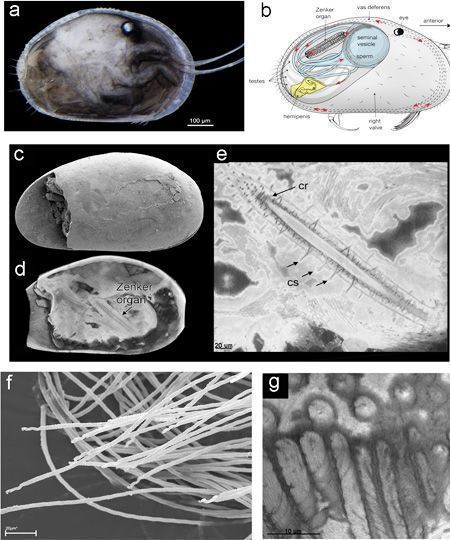
This undated handout photo combo received from on Wednesday shows details of the world's oldest and best-preserved sperm, dating back 17 million years: a. Specimen of the modern Australian ostracod Newnhamia fenestrata with the right valve removed. b. Sketch of a male ostracod, or mussel shrimp, showing the organization and orientation of the reproductive system. c. Scanning electron microscopic image of Riversleigh fossil shrimp seen from the left side, with left valve partly missing. d. Virtual reconstruction of fossil showing one of two Zenker organs. e. Details of fossil Zenker organ and chitinous rings around the central tube and chitinous spines. f. Spiralled giant sperm in modern Australian mussel shrimp. g. Spiralling of giant sperm in fossilized mussel shrimp. The sperm from an ancient species of tiny shrimp was discovered at the Riversleigh World Heritage Fossil Site, an area in the far north of the state of Queensland where many extraordinary prehistoric Australian animals have previously been found. / AFP-Yonhap
By Kim Tong-hyung
Scientists reported the discovery of the world’s oldest-known petrified, fossilized sperm, reports said Wednesday.
In a new study that will appear in the next edition of peer-review journal Proceedings of the Royal Society B, the researchers claimed that the sperm, discovered in an Australian cave, dates to at least 16 to 17 million years ago and were found in a stable state of preservation.
The animal that produced these sperm belonged to the class of mussel shrimp. The researchers had found four fossilized female mussel shrimp and one male shrimp, which was discovered with the sperm in its body. Although these shrimps measure just millimeters long, their sperm often reaches more than 1 centimeter in length.