Doosan rebounds on Bobcat recovery
By Kim Yoo-chul
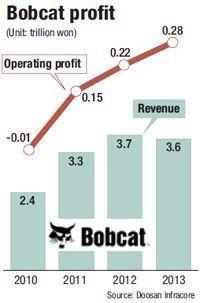
Doosan Infracore, the flagship of Doosan Group, is showing signs of a rebound on the back of improving performances by its U.S. compact equipment business, Bobcat, powered by a recovery in the U.S. construction market.
Bobcat is a U.S.-headquartered manufacturer of farm and construction equipment and is part of Doosan Infracore, a key affiliate of Doosan Group, the nation’s oldest industrial conglomerate. In 2007, Doosan acquired Bobcat from Ingersoll Rand for $4.9 billion, the biggest overseas acquisition by a Korean company.
The sales of Bobcat increased by 6.4 percent to 879.9 billion won in the fourth quarter from a year ago, thanks to an increase in the sales of key products such as compact loaders. Its operating profit margin improved from 5.1 to 11 percent during the same period.
As a result, its annual sales declined by 2.5 percent year-on-year last year, but its operating profit increased by 26 percent and its profit margin increased from 6.1 to 7.9 percent, according to Doosan. It accounted for 46.3 percent of Doosan Infracore’s revenue.
“Boosted by Bobcat’s stellar performance, Doosan Infracore is on track for a full recovery. It sees healthy demand for Bobcat’s excavators in China and Bobcat’s better product mix among major dealers. We believe this year will be much better for Infracore both in terms of market share and profitability,” said Shinhan Investment analyst Park Hyo-eun.
In 2013, Doosan’s debt-ratio on a consolidated basis also decreased from 400 percent to 283.7 percent, the company said.
“Bobcat was a problem for the group. Now, it is Doosan’s key cash cow. As economies in Europe and the United States recover steadily, Bobcat will receive more orders for compact equipment,” said a Doosan spokesman who declined to be named.
With improvements in business performance coupled with U.S. market recovery, Doosan is expected to launch an initial public offering (IPO) for Bobcat to raise more funds because the housing sector in the United States is in its favor.
Doosan Infracore said it recently established Doosan Infracore Bobcat Holdings (DIBH), a 100-percent subsidiary that will control Doosan Infracore International (DII) in the United States and Doosan Holdings Europe (DHEL). DIBH owns 88 percent of DII and 78 percent of DHEL.
“The establishment of DIBH means that the group is ready to list Bobcat on the NYSE. I don’t know when the IPO will materialize; however, it will take at least two years from now. As Bobcat is on the rise, the IPO will attract investors,” said a senior fund manager at a U.S.-based major investment bank in Seoul by telephone.
“Infracore will benefit from lower interests in borrowing and cut its debts significantly,” said the senior fund manager.
The Doosan spokesman said DIBH was established to improve management efficiency and assign responsibility to top management in DII and DHEL.
In September last year, Doosan Infracore’s borrowings totaled 6.39 trillion won. It had 369 billion won in operating profit on a consolidated basis but had a net loss of 100 billion won from interest payments from the $3.9 billion it had raised from financial markets for the Bobcat acquisition, said Doosan officials.
With Bobcat’s recovery, experts said that Doosan’s efforts to reorganize the group have paid off.
Initially, the soundness of the acquisition had been questioned. Bobcat suffered significantly from the U.S. subprime mortgage crisis, which started a year after the acquisition. Many believe this contributed to Doosan Group’s problems as well.
Because Bobcat specializes in compact construction machinery, the slump in the U.S. housing market led to a total of 2.5 trillion won in operating losses for Doosan over two years from 2008.
This prompted the U.S. unit to announce a heavy restructuring plan in personnel and some key facilities in September 2009, including the closure of a Bobcat factory in Bismarck, North Dakota, which had reopened in April 2012 to meet the increasing demand fo compact equipment.