FKI warns of slowing growth in China, Europe
By Kim Yoo-chul
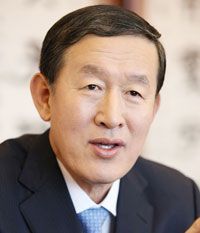
Huh Chang-soo FKI chairman
The Federation of Korean Industries (FKI), the country’s largest business lobby, warned on Wednesday that growing economic uncertainties in China and Europe are the biggest challenges facing Korean exporters.
FKI head Huh Chang-soo asked companies to boost spending on facilities and develop new business models to brace for the uncertain outlook in major markets.
“Korean industries are facing major challenges both inside and outside. The situation in China and Europe is quite serious. That’s not a temporary factor,” Huh said during the annual FKI forum held in Jeju Island.
“Korean industries might lose growth momentum. The economic woes in Europe could continue for the next few years. I see a clear sign that the Chinese economy is slowing down. Growths in emerging markets also failed to meet expectations.”
The GS Group chairman said that Europe’s debt crisis is exacerbating, posing a challenge to Korean exporters.
According to him, Korean industries are being pushed to the corner due to those factors. He asked firms to implement contingency measures to offset such risk factors.
“There are expectations that the Korean economy might expand by less than 3 percent this year. The outlook for economic improvement is not bright,” Huh said.
Such pessimistic views are well articulated in an analysis by Matthew Circosta at Moody’s Analytics.
On Wednesday, the economist wrote a memo to clients that Korea is likely to have another quarter of below-trend growth in the second quarter, reflecting domestic weakness and a loss of market share to Japan.
“Exports struggled in the face of Japanese competition as the weaker yen took a heavy toll. Foreign sales of Korean-made autos have been sliding since mid-2012, and the trend has worsened since Japan started aggressively easing policies in September. Despite a lift from the launch of new smartphones, exports across the board are mostly down,” Circosta wrote.
Citing Korea’s resilience in coping with the Asian financial crisis in the late 1990s, Huh urged firms to develop new growth engines.
“For a better future, we should find a breakthrough. The FKI will try hard to support the government’s drive for a ‘creative economy’ to develop new business models,” Huh said.
“Korea now is home to top-notch shipbuilding, car and consumer electronics companies. I believe such achievements were due to diligence and a ‘can-do’ spirit. This is also the result of collaboration between the government and industries.”
“Companies should be aggressive in investments and the government should apply pro-business policies,” he added.
The FKI said Samsung Future Technology Foundation Chairman Choi Yang-hee, KT president Kim Hong-jin, SK Planet CEO Seo Jin-woo, Google Korea CEO Yeom Dong-hoon, Science, ICT and Future Planning Minister Choi Moon-ki and Finance Minister Hyun Oh-seok will deliver their own speeches at this year’s forum.