Samsung ups stake for home appliances

A model poses with Samsung’s washer that received an award from the government for adopting energy-saving technologies, Sunday. / Courtesy of Samsung Electronics
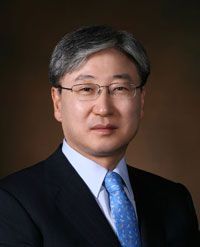
Yoon Boo-keun, co-CEO of Samsung Electronics
By Kim Yoo-chul
Samsung Electronics has undisputable leverage in such areas as smartphones, televisions, semiconductors and displays.
But it’s been quite tough to boost sales of home appliances due to their weak brand recognition on the global market.
Samsung officials admit it is challenging to compete with global appliance giants such as Whilrpool of the United States, Electrolux of Sweden and Miele of Germany.
However, the Korean firm is moving step by step to achieve its goal of becoming the world’s top home appliances maker by 2015 with $18 billion in sales under co-CEO Yoon Boo-keun, better known by his nickname “Mr. TV.”
Yoon leads the home appliances, printers and medical equipment businesses, which are viewed as Samsung’s next cash-cows.
Yoon, who was the chief of Samsung’s TV business until 2011, was appointed to handle those thin-margin businesses in 2012 with a mission to replicate the success he had in the TV business.
He played a crucial role in overseeing Samsung’s ending of Japan’s 30-year-long dominance of the global TV industry in 2006.
“Considering his proven track record with the TV business, Yoon will complete his new mission. Samsung’s home appliance unit has been improving fast under Yoon’s leadership,” a Samsung official said Sunday.
Samsung became the nation’s top manufacturer of air-conditioners by surpassing its rival LG Electronics last year. It also signed a partnership agreement with Trane of the United States to boost its presence in the global air-conditioner market.
“Samsung’s fundamentals are getting stronger. With increasing returns plus lower volatility and capital intensity, Samsung stocks is looking cheaper than ever,” said Mark C. Newman, a senior analyst at Bernstein Research, in Hong Kong.
Achievements
Under Yoon, its appliances segment is drawing more attention. Samsung officials said Samsung’s employees are impressed that the firm overtook LG in air-conditioner sales last year.
Data from GfK, a leading global research consultancy, said Samsung secured a 47.2 percent share in air-conditioner sales in 2012, ending LG Electronics’ dominance for the last three decades.
“In 2012, Yoon said Samsung was going to become Korea’s top air-conditioner maker and it will become a catalyst for its global expansion. Yoon fulfilled this pledge,” said the Samsung official. Rival LG also has the same goal of becoming the global No. 1 by 2015 in home appliance sales.
The official said Samsung’s edge in manufacturing and increased brand awareness in TVs and smartphones will pay off for its appliance business.
The company is giving up unprofitable businesses and instead boosting investment in research to meet various consumer tastes.
Yoon believes that he can generate profits from appliances sales regardless of market fluctuations.
“That’s why we are investing more in expanding distribution channels. Once the system is stabilized, then you just need to produce products according to schedule,” said the official.
Printers and medical equipment businesses are other areas to which Samsung has keen attention. Yoon is making efforts to solidify Samsung’s dominance in these areas as well.
In March, Samsung teamed up with German-based Getronics as a strategy to boost its presence in the managed print service (MPS) segment.
Samsung officials said Getronics, which has partnerships with Dell, Cisco Systems and Microsoft, is offering its MPS services to Clarks and McDonald’s.
“Utilizing our manufacturing technology and the business experiences of Getronics, we hope to rise as a serious challenger soon in those segments,” said another Samsung official.
Yoon also manages Samsung’s corporate design center and handles the medical equipment business, which was transferred to his consumer electronics division this year.
“The medical equipment business is highly-promising. That’s why Samsung identified it as another new cash cow. But there are huge barriers. We are trying hard to expand our leadership in hardware technologies to the medical equipment business in a very organized way,” said the official.
Samsung Electronics acquired a controlling stake in Korean ultrasound equipment firm Medison in 2010, and its affiliate later, for around $300 million in total, the biggest ever acquisition in the local healthcare industry. Also, it acquired another medical equipment supplier Nexus last year.
Yoon forecasts sales from its medical devices will reach $500 million this year, up from last year’s $300 million.
Sales will grow further with the acquisition of companies that make MRI scanners and computed tomography machines, he said.
Samsung Electronics says it plans to spend 1.2 trillion won in the medical equipment business by 2020 to make it a $10 billion operation with 9,500 employees.
“It may be hard to achieve those goals. In the long run, we aim to become a global healthcare leader, which isn’t an easy job,” the official said.
“At the same time, we should surpass existing home appliances titans such as Whirlpool, General Electric and Miele. Under Yoon, Samsung became the top TV producer for the seventh consecutive year. We hope he will repeat the success story in other areas.”