All-star delegation to accompany President

Samsung Electronics Chairman Lee Kun-hee and his wife Hong Ra-hee, director of Leeum Samsung Museum of Art, enter the departure lounge of Gimpo International Airport to leave for the U.S., Saturday, as part of the Korean delegation accompanying President Park Geun-hye. Their son Lee Jay-yong, second from right, vice chairman of Samsung Electronics and Choi Gee-sung, head of Samsung’s corporate strategy office, follow behind the couple. Yonhap
By Kim Yoo-chul
President Park Geun-hye’s visit to the United States is aimed at showing her resolve to tackle any uncertainties related to North Korean threats and help leading Korean conglomerates convey their competitive advantages to U.S politicians and businessmen.
Analysts and officials from South Korean industries say the visit has two main goals _ easing concerns about external risks for the Korean economy and informing the world Korean companies are worth investing in.
Park is expected to engage in active “sales diplomacy” during her meetings with American businessmen.
“There have been numerous media reports that the Korean economy is being negatively affected by North Korea’s provocations. However, we are confident that the decision by major conglomerate executives to accompany Park to the U.S. will help ease concerns about the Korean economy,” said Cho Won-dong, chief economic adviser to Park, in a briefing to reporters, last week.
Speaking of the largest economic delegation in Korea’s history, which includes the chairmen of the nation’s top three conglomerates, Im Sang-hyug, the head of public relations division at the Federation of Korean Industries (FKI), said the scheduled meetings between the Korean economic delegation and CEOs of leading companies in the United States will help Korea build trust with international investors.
Korea and the United States have already concluded a bilateral free trade agreement. Trade between the two sides exceeded $58 billion last year, according to the FKI.
The economic delegates plan to meet their U.S. counterparts to promote bilateral business cooperation.
Specifically, the FKI agreed with the U.S. Chamber of Commerce to hold a “Korea-US CEO Round Table,” during which they will discuss ways to strengthen their partnership for development of next-generation businesses.
The chairmen from General Motors, Boeing, Qualcomm and Citi are set to attend the meeting, and Park will give a keynote speech to explain her economic policies and listen to their views on pending economic issues, said FKI officials.
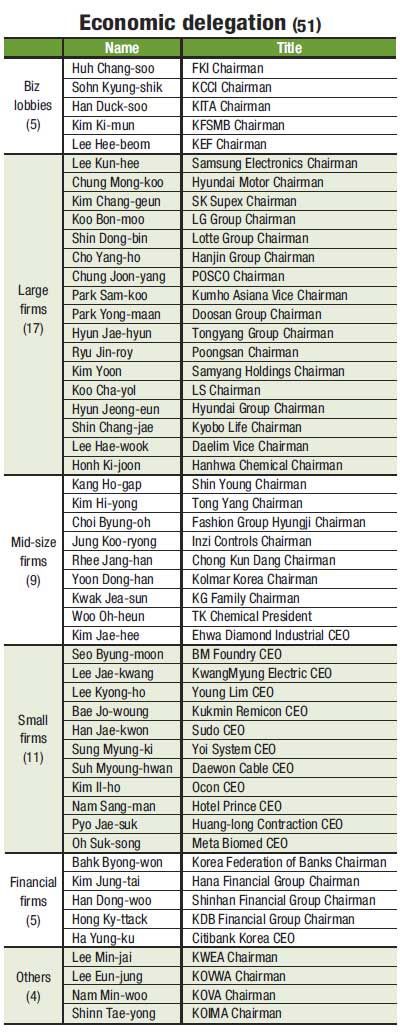
Samsung Chairman Lee Kun-hee, Hyundai Motor Chairman Chung Mong-koo and LG Chairman Koo Bon-moo are accompanying the first Korean female president.
Lee hadn’t previously been scheduled to go with the president due to several pending issues. However, he changed his mind to help Park overcome the county’s economic difficulties, Samsung officials said.
LG officials said Koo will hold several meetings with U.S. businessmen and meet with LG executives there to inspect LG’s businesses in the U.S.
LG runs a battery plant in Michigan and its affiliates have recently increased investments in the U.S.
Chung will have a busy schedule, also. He is set to find new business chances as the weakening yen threatens the group’s bottom line, said Hyundai officials.
As a political gesture to encourage stronger ties between Seoul and Washington, the Korean economic delegation is also scheduled to meet the Speaker of the House.
Additionally, the delegation will attend an official dinner commemorating the 60th anniversary of the alliance between the two countries.
Economic democratization
The U.S. visit will also give Park and the accompanying businessmen an opportunity to discuss strategies for her “economic democratization” drive.
As the president puts more emphasis on seeking balanced and shared growth with local small- and medium-enterprises (SMEs) to cut Korea’s heavy dependence on conglomerates, the FKI suggested the participation of Korea’s top three business tycoons is a gesture of their support.
In a meeting with local reporters before his departure to the United States, Chung said the world’s sixth-largest automaker will be consistent in cooperating with the government’s policy by hiring more people, increasing investment on facilities and sharing technologies with its suppliers.
Under the SME-oriented drive, the Park administration will counter the vast power of family-controlled conglomerates, known here as chaebol.
Park also promised a tougher line against conglomerates and to deal sternly with the cross-holding system in chaebol, which enables owners to control entire affiliates with only a small stake.
Park is emphasizing jobs over profit maximization. She has also pledged to be tough on wrongdoings by chaebol owners, while vowing to increase investment in social welfare.
“That’s why 20 CEOs from SMEs are also accompanying Park. During their visit, the SMEs will be given the chance to meet chairmen of the leading conglomerates and to speak to the president about issues they want to solve,” a government official said.
Under the new government, a growing number of conglomerates are teaming up with their parts suppliers to jointly advance into overseas markets.