STX tries hard to rebound

The headquarters of STX in downtown Seoul
Investors split over future of shipbuilding conglomerate
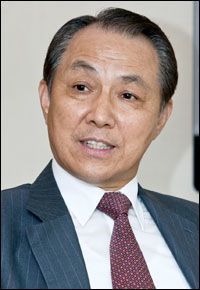
Kang Duk-soo STX chairman
By Kim Yoo-chul
Mid-tier conglomerate STX went through tough times this year due to severe cash shortage but is seeking a turnaround in 2013 after securing cash by offloading cash-cow units.
Market analysts have mixed views for STX. Some say that its bold move will help the conglomerate get back on track, while others counter that it will continue struggling to stay afloat due to the unfavorable business environment.
``STX will pay back the maturing 1.22 trillion won in debt with proceeds from the sale of its core assets. The ongoing restructuring of affiliates will help investors improve their sentiment on STX-related stocks from next year,’’ said Shinhan Financial analyst Byun Jeong-hye in a note to clients.
STX officials admit that it will be difficult for the group to ensure stable management of the shipbuilding and shipping businesses without drastic measures. They stressed the group will try to regain market confidence through restructuring.
The corporation has raised 1.12 trillion in cash by selling its stakes in European affiliate STX OSV to Italian shipbuilder Fincantieri SpA for 768 billion won and STX Energy to Japan’s Orix for 360 billion won. The group also plans to sell its stake in STX Pan Ocean, the nation's leading bulk carrier.
``The key issue is that whether STX can survive in the cyclical shipbuilding and shipping markets. The markets are seeing major consolidation just like chips and flat-screens saw a few years ago,’’ said an industry source, asking not to be named.
Despite an improvement in investor sentiment, some analysts and investors think that more time is needed for STX to clear lingering woes over liquidity problems.
Citing steep falls in dry bulk freight rates and a collapse in new demand for premium vessels amid the global economic slowdown, they stress that the time has not ripened to buy shares of the group and its affiliates.
``By selling key assets, STX is seeking to solidify its financial health. But it is not enough to save the group, which has been suffering from snowballing debt,’’ said a senior fund manager from a major U.S.-based investment bank based in Seoul, asking not to be named.
The Korea Investors Service (KIS) has downgraded its rating for corporate bonds of STX, STX Pan Ocean and STX Offshore and Shipbuilding to BBB plus from A minus. Korea Ratings also cut STX Engine to BBB plus.
``It’s no surprise that local credit rating agencies cut their rankings of STX Group affiliates as the total debt for them rose to a record 12 trillion won by September this year. Since 2009, deteriorating market situations have dented balance sheets at the group’s key businesses,’’ said another fund manager from a Europe-based investment bank in Seoul by telephone.
STX should pay back 1.5 trillion won in debt that matures next year.
``The entire group needs to secure its bottom line. Without future restructuring, we aren’t ruling out the possibility that the group will face tougher times ahead,’’ said an official from Korea Ratings.
The shipbuilding market is cyclical and volatile depending on macroeconomic situations. When the global economy is on a healthier track, shipbuilders create more revenue as they receive more orders.
But clients cancel previous orders when the economy is in trouble. In a bleak economy, the market usually reels from excess fleet capacity, causing the Baltic Dry Index (BDI) ― a global gauge of dry-bulk freight costs ― to fall.
``STX Group was too aggressive in expanding its businesses. Survival is the key word for the group,’’ said an unnamed STX official.