SK bioscience aims to boost competence with cell-based flu vaccine
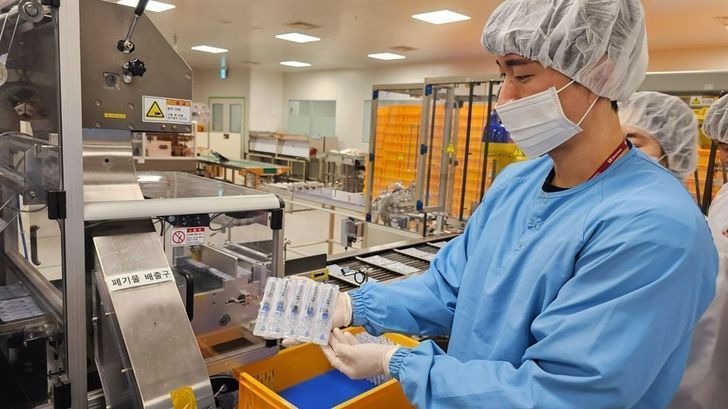
An SK bioscience employee poses with the company's cell-based influenza vaccine SKYCellflu at the company's L HOUSE vaccine production facility in Andong, North Gyeongsang Province, Tuesday. Korea Times photo by Baek Byung-yeul
By Baek Byung-yeul
ANDONG ― SK bioscience's L HOUSE plant in Andong, 270 kilometers southeast of Seoul, played a key role in protecting lives during the pandemic by producing COVID-19 vaccines. The Korean vaccine maker said Tuesday that sales of its SKYCellflu influenza vaccine began in Korea, Wednesday.
SK bioscience launched SKYCellflu in 2016. The vaccine is the country's first quadrivalent cell culture-based influenza vaccine. A quadrivalent vaccine is designed to protect against four different flu viruses. The company developed the vaccine as health authorities around the world are increasingly recommending the use of quadrivalent vaccines, which are more resistant to mutations than traditional trivalent vaccines, due to the increasing number of strains of the flu virus.
The company said the SKYCellflu vaccine is more advanced than traditional vaccines produced through the egg adaptation method and is safer for patients with egg anaphylaxis or egg allergies and requires shorter production time than egg-adaptation vaccines, which enables quicker responses to the emergence of flu viruses.
The company suspended production of the SKYCellflu vaccine during the COVID-19 pandemic to focus on manufacturing the COVID-19 vaccine. But SKYCellflu production resumed recently in preparation for the upcoming winter season.
“Deliveries began on Wednesday and we will provide about 5 million doses of the vaccine to hospitals in Korea between the end of this year and early next year,” Lee Sang-gyun, head of L HOUSE plant, told reporters. “About half of the production will be purchased by national agencies through the national immunization program (NIP), while the other half will be distributed through the private market.”
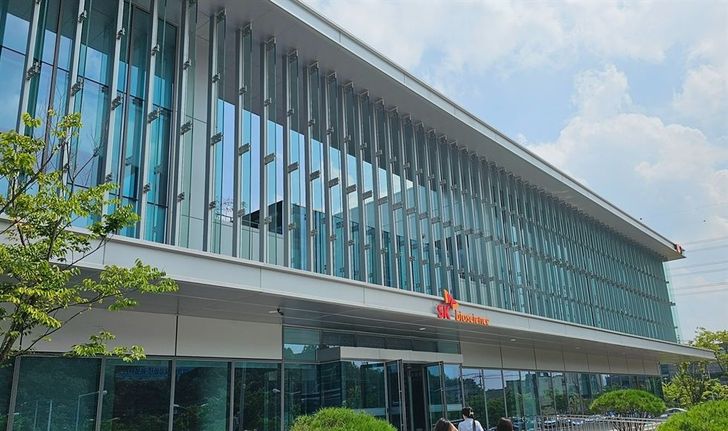
Seen is SK bioscience's L HOUSE vaccine manufacturing facility in Andong, North Gyeongsang Province, Tuesday. Korea Times photo by Baek Byung-yeul
SK bioscience showed the production line of SKYCellflu to reporters visiting the factory and emphasized that its vaccine product has an advantage of being safer than other flu vaccines.
“Unlike the egg-adaptation method, the cell-based flu vaccine is produced in sterile incubators, so no antibiotics or preservatives are required, which reduces the risk of hypersensitivity reaction to the vaccine,” the company said.
It added that its vaccine products are also more stable in terms of effectiveness, saying cell-based flu vaccines are less likely to mutate.
Based on these strengths, SKYCellflu has the largest market share in Korea. The product was also approved in 10 countries, including Malaysia, Thailand, Singapore and Mongolia, and is currently in the process of being licensed in 10 more countries, expanding its global presence, SK bioscience said.
SK bioscience said the flu vaccine market is growing globally and it expects SKYCellflu to stand out not only in the domestic market but also overseas. According to 2021 data from U.S.-based market research firm Allied market Research, the global influenza vaccine market size is expected to grow to $101.27 million in 2030, from $60 million in 2020.
“This return to the vaccine market will ensure that our people have a wide range of vaccine options, and we will continue to demonstrate the competitiveness of our vaccines as we expand our global reach,” the head of the plant said.