Korean battery makers in dilemma over sharing tax credits with US carmakers

LG Energy Solution's (LGES) factory in the U.S. state of Michigan / Courtesy of LGES
By Park Jae-hyuk
Korean battery makers are troubled over possibly worsening profits, due to potential requests from U.S. carmakers to share federal tax benefits given to battery plants built independently by Korean firms, according to industry officials, Monday.
Japan's Panasonic, which holds the largest U.S. market share thanks to its partnership with Tesla, has already indicated its intention to allow its clients to share benefits from the advanced manufacturing production credit (AMPC).
“Among the 45 billion yen ($317 million) worth of AMPC during the second quarter, Panasonic only reflected 20.8 billion yen in its operating profit,” Hana Securities analyst Kim Hyun-soo said. “Regarding the remaining half, the company said it is considering 'effective use of credit with customers.'”
The analyst anticipates it will be difficult for Korean battery makers to avoid sharing their tax credits with U.S. clients.
“During the second half of this year, they are highly likely to consider changing their accounting methods and their plans regarding the use of the credits,” he said. “Investors, therefore, need to take account of possible changes in their earnings.”
LG Energy Solution (LGES) reflected 211.2 billion won ($162 million) worth of AMPC in its first-half operating profit. The company has remained uncertain about sharing tax benefits with its U.S. clients.
“Considering the strategic partnership with our clients and price competitiveness, we are discussing ways to share benefits from the AMPC,” LGES Chief Financial Officer Lee Chang-sil said in a conference call on second-quarter earnings last month.
The CFO, however, said the company is still questioning the sustainability of the Inflation Reduction Act (IRA), a law that stipulates details about the AMPC.
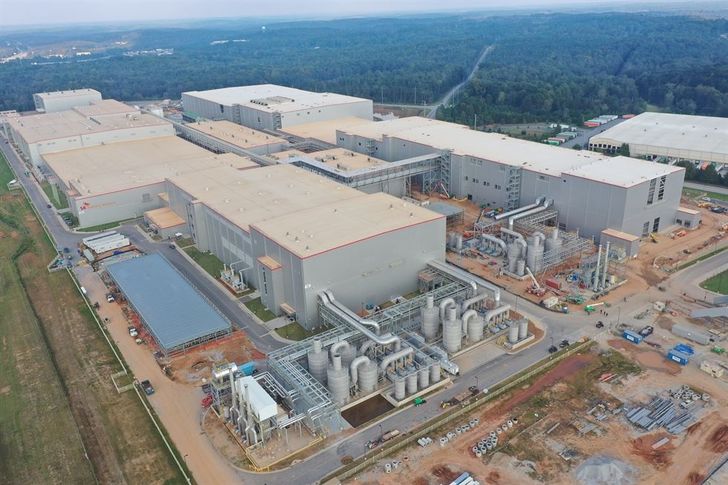
SK On's factory in the U.S. state of Georgia / Courtesy of SK On
SK On, which saw the smallest quarterly operating loss during the second quarter thanks to 167 billion won worth of AMPC, has ruled out the possibility of allowing U.S. carmakers to enjoy benefits from tax incentives given to its independent battery plants.
Given that a larger AMPC in the second half is expected to enable the company to turn a profit during the fourth quarter, SK On is expected to maintain its current stance.
“Joint ventures with U.S. carmakers receive the entire AMPC given to joint battery plants,” an SK On official said during a conference call on second-quarter earnings last month. “As SK On made direct investments in independent factories, we do not have any plan to share the benefits from the AMPC.”
Samsung SDI has yet to have an independent plant in the U.S., so the company is currently irrelevant to the controversy.
Some industry officials expect Korean battery makers to be able to maintain their partnerships with U.S. carmakers, even if they do not share their tax incentives.
“Unlike Panasonic relying heavily on Tesla, Korean firms have greater bargaining power,” an industry official said on condition of anonymity.