Kolmar nurtures organoid culturing as new growth engine

A NEXT&BIO researcher handles samples at Korea University in northeastern Seoul. Courtesy of Kolmar Korea Holdings
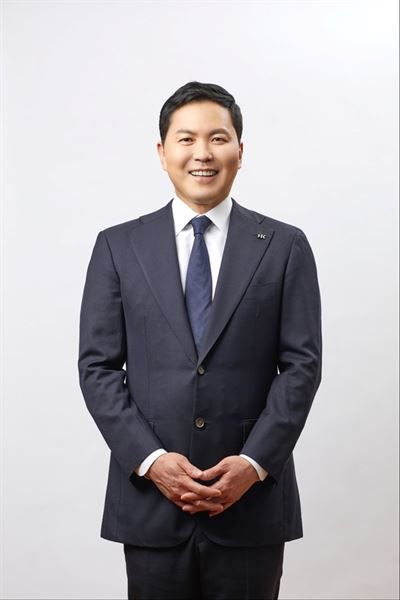
Yoon Sang-hyun, vice chairman of Kolmar Korea Holdings / Courtesy of Kolmar Korea Holdings
By Lee Kyung-min
NEXT&BIO, a subsidiary of Kolmar Korea Holdings, a local beauty and bio health care company, is fostering organoid businesses to speed up commercialization and mass production of cultured products for tailored illness treatments and to replace animal testing, the firm said Thursday.
The term organoid refers to a miniaturized and simplified version of an organ produced in vitro in 3D that mimics the key functional, structural and biological complexity of that organ.
NEXT&BIO signed an agreement with Singapore-based Aimbiotech last August to jointly develop a lung cancer immuno-cancer drug candidate discovery and evaluation system, as mediated by “organoid-on-a-chip.”
The local Kolmar subsidiary plans to introduce a platform technology that accurately evaluates the effectiveness of treatment, mostly through organoid culturing with samples from lung cancer patients.
According to the Center for Biotechnology Policy Research, the global organoid market is expected to register an annual average growth of 20 percent from 780 billion won ($610 million) in 2019 to 3.8 trillion won in 2027.
As of 2019, North America and Europe have global organoid market shares of 42.3 percent and 36 percent, respectively.
Asia-Pacific markets including China, Japan, India and Korea are expected to grow to 660 billion won in 2027, up from 125 billion won in 2019.
Further bolstering the growth prospect is the government designation of organoid technology as a national strategic technology, alongside semiconductors, displays and rechargeable batteries.
Kolmar Korea Holdings Vice Chairman Yoon Sang-hyun played a key role in outlining the corporate growth strategy to acquire NEXT&BIO.
NEXT&BIO is seeking to expand into the global market.
In 2021, it signed a license agreement with its Dutch peer Hub Organoid to secure the right to use all organoids made by the Dutch firm.
Last year, it signed a joint research agreement with the Korea Institute of Science and Technology (KIST) to establish a protocol for animal experiments based on organoids.
NEXT&BIO plans to invest about 4 billion won to build a good manufacturing practice (GMP) facility this year. It will conduct a phase 1 clinical trial to develop organoid-based muscle regeneration therapy in the first quarter of 2024.
Animal testing for cosmetics and pharmaceutical experiments is increasingly limited, a NEXT&BIO official said.
“We have a technological advantage in the global market as a mass-producer and standardized manufacturer of organoids. Animal trials have been essential for drug development, but organoids can reduce dependence on animal testing and spur the development of new drugs.”