General strike puts brakes on Korean exports of cars, ships

Members of the Korean Metal Workers' Union under the Korean Confederation of Trade Unions hold a rally near Ichon Station in Seoul, Wednesday, urging President Yoon Suk Yeol to step down. Yonhap
By Park Jae-hyuk
Unionized workers at Hyundai Motor and HD Hyundai Heavy Industries participated in a general strike initiated by the Korean Metal Workers' Union under the Korean Confederation of Trade Unions, Wednesday. Their participation has raised concerns over potential damage to Korea's exports, which have relied heavily these days on carmakers and shipbuilders.
Hyundai Motor's union decided to down tools for two hours from 1:30 p.m. that day and another two hours from 10:10 p.m. This is the first time in five years that the carmaker's unionized workers joined a general strike launched by the umbrella union.
Their four-hour strike is expected to cause a setback in the production of around 2,000 vehicles. When the automaker's labor-management dispute flared in 2016, Hyundai Motor suffered a setback in the production of over 142,000 vehicles annually.
“Hyundai Motor union's participation in the illegal political strike will make the company lose its opportunity to take a leap forward in the global market by increasing its investments in future vehicles,” the Korea Automobile & Mobility Association said in a recent statement. “Amid the stabilization of the management of auto parts makers after the recent improvement in sales and exports, the strike will reduce automobile production and worsen the management of component suppliers.”
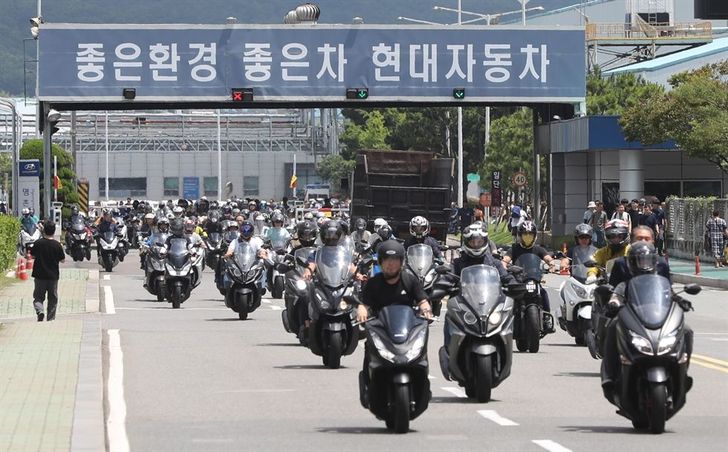
Unionized workers at Hyundai Motor leave the carmaker's Ulsan factory two hours earlier than usual to join a general strike initiated by the Korean Metal Workers' Union under the Korean Confederation of Trade Unions, Wednesday. Yonhap
Unionized workers at Motras, a Hyundai Mobis affiliate supplying components to Hyundai Motor's Ulsan factory, also staged an eight-hour strike on the same day.
“It is impossible to assess the damage caused by the strike, which will include a setback in the production of over 7,000 vehicles, around 10 billion won ($7.8 million) compensation to our client and damage to our reputation,” Motras CEO Kim Won-hyuk told the company's employees recently.
In the shipbuilding industry, HD Hyundai Heavy Industries' unionized workers agreed to a three-hour strike after their wage talks with management ended in a stalemate.
Unionized workers at seven other shipbuilders also joined the latest general strike, making it more difficult for them to supply vessels on time to clients amid the lingering shortage of shipbuilding workers.
“The growing exports of cars and ships have offset the falling exports of other products, so it is regrettable that workers of those industries joined the general strike emphasizing political propaganda,” an official at one of Korea's major business lobby groups said on condition of anonymity.
Data compiled by the Ministry of Trade, Industry and Energy showed that the respective exports of vehicles and ships last month rose 46.8 percent and 8.8 percent year-on-year, while exports of other products declined again.
The ministry also expected exports of automobiles and ships to lead the growth of Korea's economy during the latter half of this year.