Korean businesses seek to boost presence in Vietnam

A video advertisement is displayed on top of the Korean Culture Center in downtown Hanoi to commemorate President Yoon Suk Yeol's state visit to Vietnam, Thursday. Courtesy of presidential office
Top conglomerate chiefs accompany president's state visit
By Kim Hyun-bin
Korean businesses are exploring new investment opportunities in Vietnam, seeing huge potential in the rapidly growing Southeast Asian country which last year emerged as Korea's third-largest trade partner following China and the U.S.
The pivot is aimed at reducing Korea's economic reliance on China, where Korean businesses face uncertainties due to the rivalry between China and the U.S. over supply chains and other issues.
The increasing interest in Vietnam has been reflected in visits to the country by more than 200 Korean business leaders, including the chiefs of Korea's top four conglomerates, who are accompanying President Yoon Suk Yeol's state visit to the Southeast Asian country as an economic delegation.
Industry officials expect the heads of the conglomerates ― Samsung Electronics Chairman Lee Jae-yong, SK Group Chairman Chey Tae-won, Hyundai Motor Group Executive Chair Chung Euisun, and LG Group Chairman Koo Kwang-mo ― to inspect facilities there and announce new investment opportunities.
For Lee Jae-yong, Vietnam has become a regular business destination due to Samsung Electronics producing nearly half of its Galaxy smartphones in factories there. Korea's significance there is further emphasized as the Galaxy smartphone contributes to about one-fifth of Vietnam's total exports.
Yoon could accompany Lee on a visit to Samsung Electronics' R&D Center in Hanoi. Samsung Electronics currently operates six production subsidiaries, sales units and R&D centers in Vietnam, producing crucial components ranging from flagship models, home appliances, communication equipment and displays to camera modules.
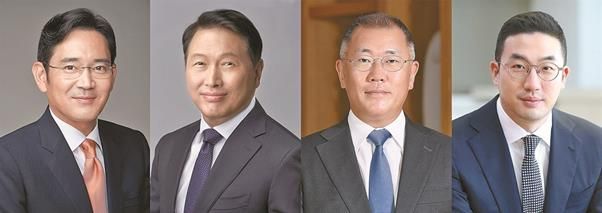
From left are Samsung Electronics Chairman Lee Jae-yong, SK Group Chairman Chey Tae-won, Hyundai Motor Group Executive Chair Chung Euisun, and LG Group Chairman Koo Kwang-mo. Courtesy of each company
SK Group has also been investing heavily in Vietnam, recognizing its growth potential. It established SK Southeast Asia Investment Corp. in 2018 and has invested in promising local companies, including the purchase of a 9.5 percent stake for $470 million in Masan Group, Vietnam's leading food and beverage and distribution company and also investing $1 billion in Vingroup.
"Vietnam is not only one of the top three trading partners alongside the U.S. and China, but also a country where businesses are engaged in operations and supply chains and strengthening cooperation in emerging industries and technological advancements. These areas can be discussed together to explore ways to enhance collaboration," an industry official familiar with the matter said.
Hyundai Motor Group has been instrumental in bringing about significant changes in the Southeast Asian and Middle Eastern markets, which were previously dominated by Japanese companies, particularly Toyota. Vietnam is one of the key countries in this regard.
In 2017, Hyundai Motor established the HTMV production joint venture with Tan Cang Group in Ninh Binh Province, surpassing Toyota within two years to become the market leader. It held the top position in terms of sales until 2021. Hyundai Motor and Kia plan to produce four additional models in the second half of this year at the HTMV 1 and 2 factories, aiming to enter the Vietnamese electric vehicle market.
LG has been involved with Vietnam since 1995 and has been increasing investments under Koo's leadership. In 2015, LG integrated the production factories of Hung Yen (TV) and Haiphong (washing machines and vacuum cleaners) into the Haiphong Campus, positioning it as a global production hub. The company plans to invest $1.5 billion by 2028 to establish and expand production lines.
LG Group operates a total of 12 subsidiaries in Vietnam, including LG Display, LG Innotek, and LG Chem, since LG Electronics entered the Southeast Asian country in 1995. With a production scale of $12 billion last year, they accounted for approximately 3 percent of Vietnam's GDP.
Meanwhile, the Korea-Vietnam Trade Consultation event took place at the Hanoi National Convention Center (NCC), Thursday, organized by the Ministry of Trade, Industry and Energy and KOTRA. The event aimed to help boost exports of made-in-Korea goods to Vietnam, including electronics, cars, home appliances, cultural content and agricultural and fisheries products.
The event also brought together 100 small and medium-sized Korean enterprises, startups, and over 200 Vietnamese buyers, resulting in more than 400 one-on-one consultations. Contracts worth up to $100 million are expected to be signed.
The K-Industry Showcase was also organized allowing Vietnamese citizens to learn about bilateral economic cooperation with more than 8,800 Korean companies, which employ over 700,000 people in Vietnam and contribute to approximately 30 percent of the Southeast Asian country's exports.