Can late-mover Korean firms outrun Chinese rivals in LFP battery market?

A prototype of SK On's lithium iron phosphate (LFP) battery for electric vehicles is on display during the InterBattery 2023 at COEX in Seoul in this March photo. Courtesy of SK On
$17 million to be injected to upgrade LFP battery technologies
By Park Jae-hyuk
Korean rechargeable battery makers still appear to have long way to go to defeat Chinese rivals in the fast-growing global lithium iron phosphate (LFP) battery market, despite financial support from the Korean government and the U.S. Inflation Reduction Act (IRA), according to a report by a state-run economic think tank, Monday.
The Korea Institute for International Economic Policy (KIEP) anticipated that it will not be easy for LG Energy Solution (LGES), Samsung SDI and SK On to vie with China's CATL and BYD, which have already integrated their supply chains vertically to secure price competitiveness before their competitors in other countries enter the LFP battery market.
“Although the IRA restricts the entry of Chinese firms into the North American market, it is inevitable for Korean companies to compete with them in the North American market, as Chinese firms are aggressively trying to circumvent the U.S. law,” said Choi Jae-hee, senior researcher of KIEP's China region and strategy team.
Korean battery makers had once been uninterested in producing LFP batteries for electric vehicles (EVs), as they were considered inferior to ternary batteries, such as nickel, cobalt and manganese (NCM) and nickel, cobalt and aluminum (NCA) batteries.
LFP batteries underperform at low temperatures and cars equipped with such batteries have shorter mileage, although they are less expensive than ternary batteries. Global EV manufacturers have therefore used ternary batteries, while Chinese carmakers have used LFP batteries.
In March, LFP batteries accounted for 70 percent of batteries installed in EVs in China. Although their proportion stood at 31 percent of the global market last year, the figure is expected to exceed 60 percent next year, considering the fact that their share rose from and 11 percent in 2020 and 25 percent in 2021.
In addition, the recent decisions of Tesla and other global carmakers to use LFP batteries for their budget EVs prompted Korean battery makers to speed up developing low-cost batteries.
During the InterBattery 2023 exhibition in March, SK On became the first Korean battery maker to showcase a prototype LFP battery for EVs. The company is expected to start mass production of the battery from 2025.
Samsung SDI also began to develop LFP batteries, in line with the trend of global carmakers producing EVs at lower prices. LGES, which is developing LFP batteries for energy storage systems, also said in a conference call last month that it is open to producing LFP batteries for EVs.
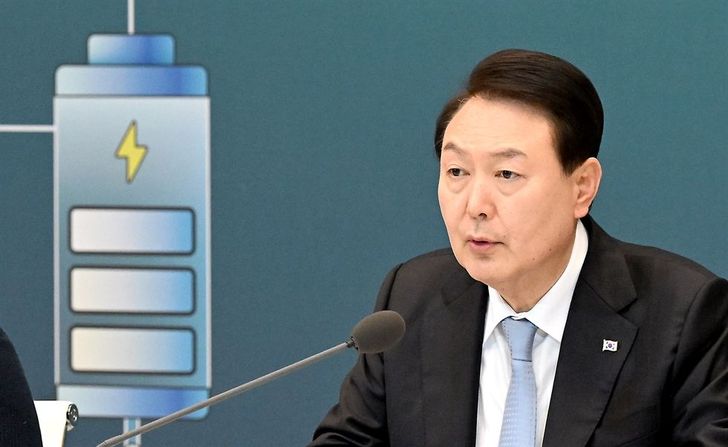
Korean President Yoon Suk Yeol speaks during a national strategy meeting on the battery industry at Yeongbingwan, a reception hall at Cheong Wa Dae, the former presidential office and residence in Seoul, April 20. Joint Press Corps
For Korean battery makers to gain a competitive edge over their Chinese rivals in the global LFP battery market, the government has decided to offer financial support for R&D projects.
The Ministry of Trade, Industry and Energy said the government will invest 16.4 billion won ($12 million) in the project until 2026 to upgrade Korea's LFP battery technologies, while the private sector will inject 6.9 billion won.
Samsung SDI, Dongwha Electrolyte, EcoProBM, Swemeka and CIS were chosen as companies to participate in the project with universities and state-run research institutes.