Korea to invest $15 bil. in EV batteries by 2030

President Yoon Suk Yeol speaks during a national strategy meeting on the battery industry at Yeongbingwan, a reception hall at Cheong Wa Dae, the former presidential office and residence in Seoul, Thursday. Yonhap
Nation aims to secure lead in solid-state batteries
By Baek Byung-yeul
Korea will invest 20 trillion won ($15.1 billion) in the electric vehicle (EV) battery industry by 2030 to turn it into a key component of the country's national security and strategic assets, along with semiconductors, and to secure a significant lead over rivals, President Yoon Suk Yeol said Thursday.
Yoon made the comments while presiding over a national strategy meeting on the battery industry with officials from the government, industry and academia at Yeongbingwan, a reception hall in Cheong Wa Dae, the former presidential office and residence in Seoul.
The president added that EV batteries are becoming more important, because they are at the center of the global race to attain technological supremacy.
“Their importance is indescribable and they are at the center of today's global race for technological supremacy,” Yoon said. “If we are overtaken by competitors on both [EV batteries and semiconductors], the impact on the entire industry will be enormous. The secondary battery sector is dependent on securing key minerals and materials. We need to diversify our supply chain by reducing our dependence on a single country, build a rich network to secure minerals and materials and reduce the cost of acquiring materials.”
To widen its lead over competitors, Yoon said industrial ecosystems, such as materials, equipment and parts, as well as labor supply and investments, are necessary.
“We need to create a robust industrial ecosystem from small parts to finished products based on a stable supply chain. We also need to expand investments so that we possess world-class competitiveness, not only in finished products, but also in materials and equipment, and we need to do everything possible to ensure that we have a timely supply of talented professionals,” he said.
The president added that “securing next-generation battery technologies will determine the future success of our battery industry,” stressing that Korea “needs to maintain its edge with technological innovations that dramatically increase performance and safety.”
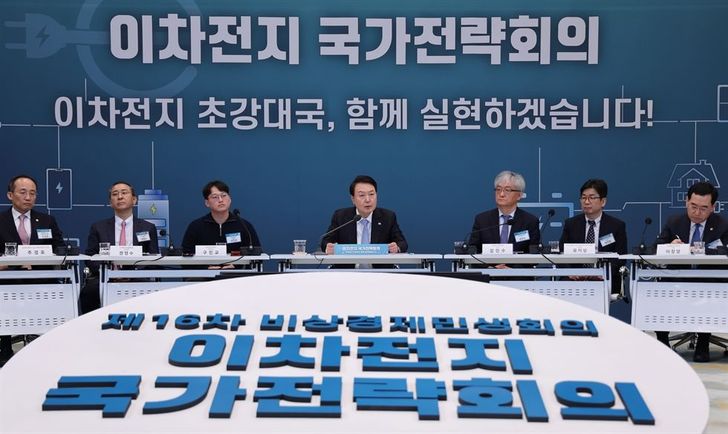
President Yoon Suk Yeol, center, speaks during a national strategy meeting on the battery industry at Yeongbingwan in Seoul, Thursday. Participants of the meeting include Choo Kyung-ho, left, minister of economy and finance, Kwon Young-soo, second from left, vice chairman of LG Energy Solution, and Lee Chang-yang, right, minister of trade, industry and energy. Yonhap
Korea's industry minister and other high-ranking officials from both the government and private businesses shared their ideas to achieve that goal.
Lee Chang-yang, minister of trade, industry and energy, said the commercialization of solid-state batteries will increase Korea's lead over its rivals, adding that the private sector and the government will jointly invest 20 trillion won by 2030 for the commercial launch of the new type of battery.
Solid-state batteries are regarded as the next big thing in the industry, because they are potentially safer and have higher energy densities compared to existing batteries by using solid electrolyte materials.
To commercialize the technology, the government will support large research projects to develop solid-state batteries, while top battery cell makers ― LG Energy Solution, Samsung SDI and SK On ― plan to produce prototypes of solid-state batteries domestically and mass produce them overseas.
To strengthen the entire battery industry ecosystem, the government plans to significantly increase tax breaks for materials manufacturers to invest in Korea and provide funds to let equipment makers conduct more research.
“As the pace of change in the global market and technology is very fast, the battery industry needs more bold innovations and investments to remain competitive. We will work together with the public and private sectors to establish Korea as the undisputed leader in technology and market share by 2030,” the industry minister said.