Partner firms follow Samsung into robot business

Models promote robots produced by Samsung Electronics. Korea Times file
By Lee Kyung-min
Electronics, electrical devices and software manufacturing partners of Samsung Electronics are seeking to expand their businesses in the robotics industries, in a long-term strategy underpinned by the robust growth outlook for automated services in the decades to come, according to market watchers, Wednesday.
Anchoring the new businesses is a 240 trillion won ($181 billion) investment announced in 2021 by Samsung Electronics Chairman Lee Jae-yong in future tech industries, including robots and artificial intelligence (AI).
Market watchers said at the time that Samsung beginning the mass production of robots will fan the prospect for small technology developers and robot manufacturers, as well as mergers and acquisition (M&A) opportunities for strong local industry players.
Data from Strategy Analytics, a global market research firm, showed that the global robotics market will grow to $122 billion by 2024. Boston Consulting Group (BCG), a global consultancy, said the market will grow to 210 trillion won by 2030, propelled by the rapid commercialization of robot-mediated services from around 2025.
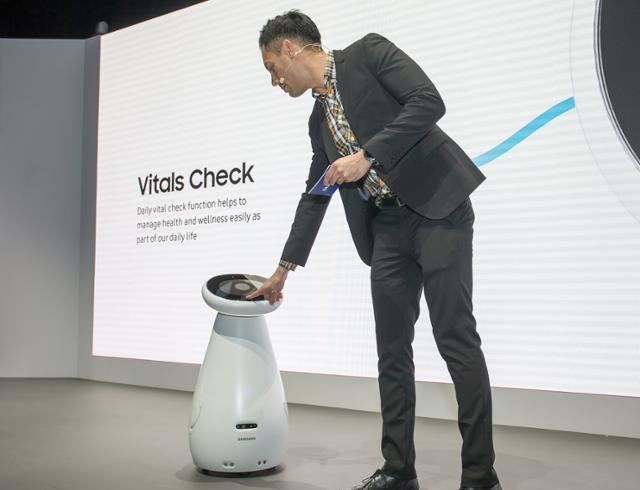
A product demonstrator shows the abilities of a healthcare robot produced by Samsung Electronics at the Consumer Electronics Show in 2019. Korea Times file
Partners
Among Samsung's partners are Intops, Meere Company and Namuga, suppliers of parts and devices to Samsung's flagship Galaxy series.
Intops, a telecommunication devices manufacturer and a household appliances mold maker, began producing components of robots with its decades of knowledge and know-how in cell phones and antenna parts.
The firm launched a collaborative partnership with Bear Robotics, a services robot manufacturer in 2020, and has since fortified technological research and development. The two are exploring opportunities to identify a wider scope or customers seeking enhanced efficiency in labor cost management.
Meere, an edge grinder developer, a device responsible for edge beveling and corner grinding in the process of LCD and OLED automatic production, has been working on developing medical robots since 2007.
It was able to develop a laparoscopic surgical robot called Revo-i in 2018. It became the second company in the world to make a robot to conduct surgery in the abdomen or pelvis using a thin rod with a camera attached. Meere began to supply Revo-I to assist operations at Yonsei Severance Medical Center in March, the first time for the robot to be utilized in a large hospital in Korea.
Also promising is the firm's success in camera technologies to commercialize 3D time of flight (ToF), a type of scanner-less light detection and ranging (LIDAR) technology that uses high-power optical pulses in durations of nanoseconds to capture depth information typically over short distances from a scene of interest.
The technology was showcased during the Consumer Electronics Show (CES) this year.
“Robotics businesses are the next growth driver not only for Samsung but its top-tier local and global market peers as well as their affiliates and partner firms,” said Korea Investment and Securities researcher Yoo Jong-woo said in a report. “The demand for robot-mediated services will spike in the years to come, in line with the rapidly aging population and technological advancements.”