Korail fined $1.4 million for safety lapses

Workers repair severed railroad tracks at Yeongdeungpo Station in southern Seoul, Nov. 7. Korea Times file
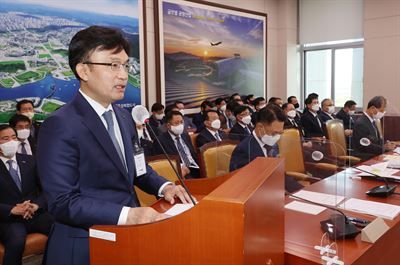
Korail CEO Na Hee-seung / Korea Times file
By Lee Kyung-min
State-run Korea Railroad Corp. (Korail) and Seoul Metro have been fined 1.92 billion won ($1.4 million) and 120 million won, respectively, for making unauthorized changes in their work-shift systems, and other violations, the transport ministry said Tuesday.
The record penalty imposed on Korail follows a 1.8 billion won fine in January.
Dismissed Korail CEO Na Hee-seung will be replaced in the first half, upon President Yoon Suk Yeol's appointment of one among a shortlist of nominees selected by a finance ministry-led recommendation committee. The committee will review candidates for one month.
The Ministry of Land, Infrastructure and Transport said the shift put in place led to fewer, entry- or junior-level Korail and Seoul Metro workers handling a greater volume of train operations, causing repeated safety lapses and a number of fatal accidents over the past few months.
“The rail operators should have sought our permission before revising their work-shift system, especially when it meant fewer numbers of employees being assigned to high-risk safety work,” the ministry said in a statement.
The ministry imposed a 720 million won fine on Korail for failing to follow safety protocols before maintenance work. This led to a power outage in a tunnel, causing the operations 189 trains to be halted or delayed.
A fine of 360 million won was imposed for the death of each worker, one in Jungnang, and the other in Jeongbalsan, both in Seoul.
A number of train malfunctions were reported last year, mostly caused by entry-level or junior employees with little experience being unable to operate the trains.
The issues took a lot longer to rectify than they normally would have, because a different worker on duty who was called to help move the train had only a few more months of experience than the one operating the train.
Another fatal incident involved a Korail worker in his 30s being hit and killed by a cargo train that was operated by an entry-level worker with less than six months of experience.
Derailments of a number of non-high-speed trains caused injuries to two dozen passengers.
The ministry announced safety-enhancing measures in January, including the remote control of train operations to gradually replace duties carried out by workers in person.
It said artificial intelligence (AI) train operating systems will be developed and implemented.