Korean, Chinese businesses urge governments to boost exchanges

Chey Tae-won, chairman of the Korea Chamber of Commerce and Industry, center, and other Korean business leaders engage in a video conference with Chinese counterparts online, Monday. Courtesy of KCCI
By Kim Hyun-bin
Korean and Chinese businesspeople agreed to bolster exchanges by strengthening a 1.5-track dialogue platform consisting of both the private and public sectors, and to promote cooperation in the second phase of Korea-China free trade agreement negotiations, industrial cooperation and carbon neutrality, according to the Korea Chamber of Commerce and Industry (KCCI), Monday.
The KCCI held the “3rd Korea-China Businessmen and Former High-ranking Government Official Dialogue” online in Seoul and Beijing Monday, together with the China Center for International Economic Exchange (CCIEE).
The first dialogue was held in 2018 to promote economic cooperation and exchanges between the two countries, and consisted of key businesspeople and former high-ranking officials from both countries, serving as a channel to discuss mid- to long-term tasks.
The Korean side of the event was chaired by Yoo Il-ho, former deputy prime minister and minister of finance, along with other business leaders, including KCCI Chairman Chey Tae-won, LS Vice Chairman Myung Roe-hyun and Park Seung-hee, president of Samsung Electronics.
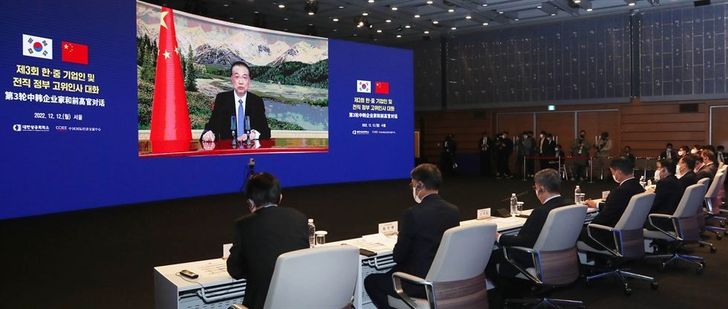
Premier Li Keqiang delivers a congratulatory speech during an online dialogue between Korean and Chinese business officials, Monday. Courtesy of KCCI
From the Chinese side, 14 people attended, including CCIEE representatives, such as its Executive Vice Chairman Bi Jingquan and Executive Vice Chairman of Commerce Xiaoqiang Zhang.
“New trade barriers such as the protection of high-tech industries, international disputes and the climate change crisis are new challenges for both countries. Economic cooperation between the two countries is also evolving anew at a time when a positive view of growing together as neighbors is needed,” Yoo, the former Korean deputy prime minister and minister of finance, said in a message of greeting.
“In the past, Korea and China have contributed to each other's economies through quantitative growth, but in the future, qualitative growth based on comparative advantages between the two countries is necessary. Based on this, let's solve the problems we face together," he said.
Following the message of greeting, Chinese Premier Li Keqiang gave a congratulatory speech by video during the event, which is being held by the Chinese side for the first time in three years. In his speech, the Chinese premier proposed future cooperation between Korea and China and offered encouragement to business leaders in both countries.
The committees from both sides then issued a joint declaration and pledged to work together to take a new leap forward in bilateral cooperation.
The joint declaration welcomed efforts to develop bilateral relations by strengthening economic and trade cooperation based on the revitalization of public-private dialogue. The two countries agreed to stabilize Korea-China trade relations by concluding phase 2 negotiations of the Korea-China FTA, to promote cooperation by utilizing the Regional Comprehensive Economic Partnership (RCEP), to expand cooperation in various industries for high-quality economic cooperation and to promote practical joint cooperation to realize carbon neutrality.
In the discussion session, various opinions were exchanged on the global economic situation, Korea-China economic development, and Korea-China economic, trade and investment relations.
“As the heads of state of the two countries said last November, it is necessary to establish a 1.5-track dialogue system in which the private sector and the government participate, and this high-level dialogue is the appropriate dialogue,” Woo Tae-hee, vice chairman of the KCCI said. “I hope that dialogue between high-ranking Korean and Chinese businesspeople will serve as a means for active exchange and communication between the two countries.”