Hyundai Motor opens Indonesian plant

Hyundai Motor Group Chairman Chung Euisun delivers a speech at the opening ceremony of the company's new factory in Indonesia's Deltamas industrial complex near Cikarang, Wednesday. Yonhap
Carmaker to compete with Japanese rivals in Southeast Asia
By Park Jae-hyuk
Hyundai Motor held a ceremony, Wednesday, to celebrate the completion of building its first Southeast Asian factory in Indonesia's Deltamas Industrial Complex near Cikarang, 40 kilometers east of the capital city of Jakarta.
The new plant will provide a foothold for the company to expand its presence in the Southeast Asian market, where its Japanese competitors have so far dominated, according to the carmaker.
Indonesian President Joko Widodo, who attended the ceremony with the country's top government officials, offered his congratulations for the completion of the factory's construction and the beginning of its production of the IONIQ 5, the first electric vehicle (EV) produced in Indonesia.
“I hope that this IONIQ 5 from Hyundai will become an important milestone in the development of Indonesia's electric vehicle ecosystem, and to further accelerate the electric car ecosystem that is more advanced,” he said.
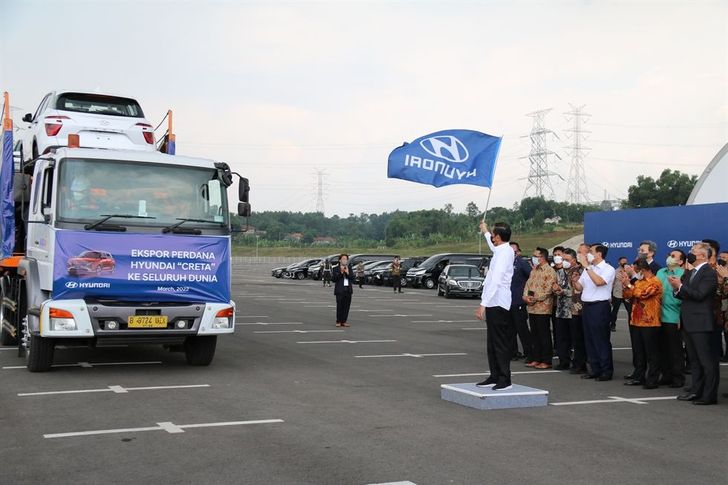
Indonesian President Joko Widodo waves Hyundai Motor's flag at the new Deltamas industrial complex factory near Cikarang, Wednesday. Yonhap
Hyundai Motor Group Chairman Chung Euisun emphasized that the world's fourth-most populous country is a key hub for his company's future mobility strategy.
“This plant will play a key role in the automotive industry and specifically in the field of electric vehicles,” he said. “Hyundai Motor will keep contributing to the establishment of the electric vehicle ecosystem in Indonesia through synergies with the battery plant that we are currently developing. This will boost Indonesia to play an important role in the global landscape.”
Hyundai Motor plans to invest $1.55 billion to increase the Indonesian factory's annual production capacity to 250,000 units.
The new plant has produced the Creta subcompact crossover SUVs since January and started manufacturing the IONIQ 5 EVs after Wednesday's completion ceremony. It will begin producing the Santa Fe SUVs during the first half of this year, as well as small strategic multi-purpose vehicles tailored for Southeast Asian customers in the second half.
The made-in-Indonesia vehicles can be exported to other ASEAN countries without tariffs, in accordance with the ASEAN Free Trade Area agreements.
Considering that the Indonesian government is spearheading the expansion of an EV ecosystem, with its plan to convert 130,000 government vehicles to EVs by 2030, Hyundai Motor is also working with LG Energy Solutions to finish building a battery cell factory in the other Indonesian city of Karawang by the first half of 2023 and to start production there from 2024.
Hyundai Motor expects battery cells produced at the factory to support Indonesia's EV transition by providing a supply of sustainable batteries.
“The locally produced batteries will be sourced to produce EV models in the Indonesian plant, further enhancing EV models' price competitiveness,” the company said in a press release.
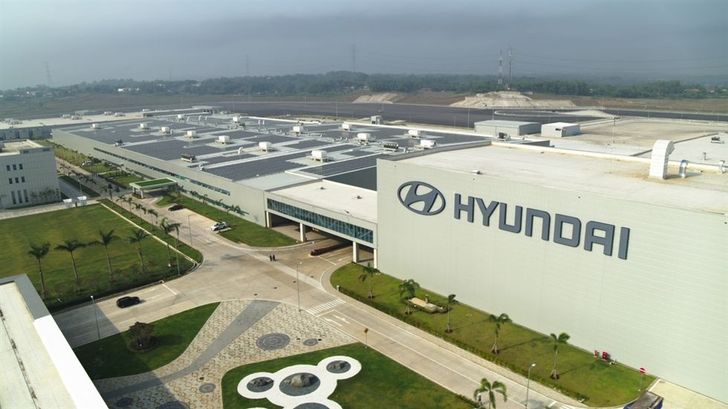
Hyundai Motor's factory in Indonesia's Deltamas industrial complex near Cikarang is seen in this file photo. Courtesy of Hyundai Motor
For Indonesian and other Southeast Asian consumers, Hyundai Motor also aims to take a customer-centered approach in terms of production and sales, based on a build-to-order scheme, which allows customers to choose product specifications when ordering vehicles and lowers inventory costs.
Its click-to-buy online platform in Indonesia will also enable customers to carry out all stages of the vehicle purchase experience from home, according to the company.