Complaints growing over luxury items sold online

Online luxury mall Tren:be CEO Park Kyung-hoon, left, holds a handbag at the company's headquarters in Seoul in this 2021 file photo. Korea Times file
By Kim Jae-heun
Soaring demand for luxury products amid the ongoing COVID-19 pandemic has not only profited department stores, but also newly emerging online luxury shopping channels. However, the quality of items sold on the internet has emerged as a source of consumer complaints, according to industry watchers and consumer advocacy groups, Sunday.
A controversy emerged in early January when Naver's online resale platform, KREAM, argued that Musina was selling fake apparel by the “Essentials” brand.
Musinsa is the country's largest fashion platform, which surpassed 2 trillion won in gross merchandise value for the first time in 2021. The Korea Appraisal Institute of Luxury Goods confirmed that the products sold on Musinsa could not be authenticated due to the lack of data.
Some customers are now questioning the authenticity of luxury goods sold on the internet, something they never expected to do, as they implicitly trusted that big companies would never sell counterfeit items.
“I have purchased about 10 million won ($8,300) of luxury goods on the internet in the last year and became suspicious that some are fake. But the process of checking their authenticity is too complicated and it costs money,” said a 34-year-old named Kim.
“I use online malls because they sell products cheaper than local department stores, and appraising them would cost me the same money that I would've spent buying luxury goods at boutiques.”
A 32-year-old office worker surnamed Jeon said that she prefers the internet for buying luxury items because there is a larger variety of choices available. However, the recent controversy regarding the authenticity of certain items has changed her mind, forcing her to go back to department stores.
“I don't want to take risks buying luxury handbags and clothes online now when I am not sure if they are real, just because they are cheaper,” Jeon said. “I am already spending an average of 3 million won ($2,490) for a handbag and I don't want to end up with a counterfeit just to save 300,000 won ($249).
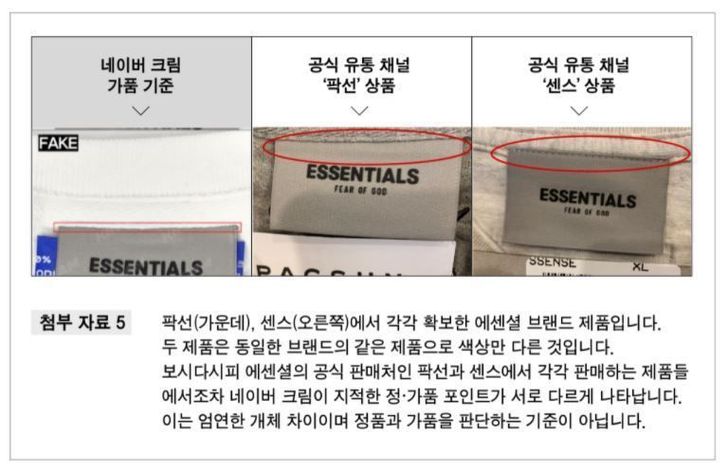
Musinsa's press kit which argues that its Essential items online are not fake / Courtesy of Musinsa
The problem is that it is hard to authenticate luxury goods, except for the products of Chanel, Louis Vuitton and Hermes. There is a lack of data on other luxury brands' items. This lack of information was the case with Essential, a sub-label of luxury street brand “Fear of God.”
Luxury brands are also refusing to check the authenticity of allegedly fake products sold in Korea online.
Local online malls do not purchase luxury goods directly from brand headquarters and instead, are in contract with second or third retailers in Europe. Some sell products personally purchased at local stores in Paris, Milan or New York, which makes it hard for the online luxury firms to check the products' authenticity.
The size of the online luxury market grew considerably in the last year. The gross merchandise value combining the top three local online luxury platforms, “MUST IT,” “Tren:be,” and “BALAAN,” reached 1 trillion won, which is up by 100 percent year-on-year.