Samsung SDI falls to 6th in global EV battery ranking

Samsung SDI headquarters in Yongin, Gyeonggi Province / Courtesy of Samsung SDI
By Park Jae-hyuk
Samsung SDI, which is less active than LG Energy Solution (LGES) and SK on in forming partnerships with electric vehicle (EV) manufactures in the U.S., has been trailing its Korean competitors in terms of the global EV battery market share, according to the latest industry data Monday.
The public company ranked sixth in the global EV battery market share last year, yielding fifth place to SK on, according to the data compiled by an energy market tracker, SNE Research. Samsung's market share dropped to 4.5 percent from 5.8 percent a year earlier, while SK's rose to 5.6 percent from 5.5 percent the previous year.
LGES maintained second place, following China's CATL, although the Korean firm's market share fell to 20.3 percent from 23.4 percent a year earlier.
Samsung SDI began lagging behind SK on in global market share since last July.
The battery manufacturing unit of Samsung has focused more on enhancing its profitability, as its management has emphasized qualitative growth based on technical skills and reduced emphasis on quantitative growth.
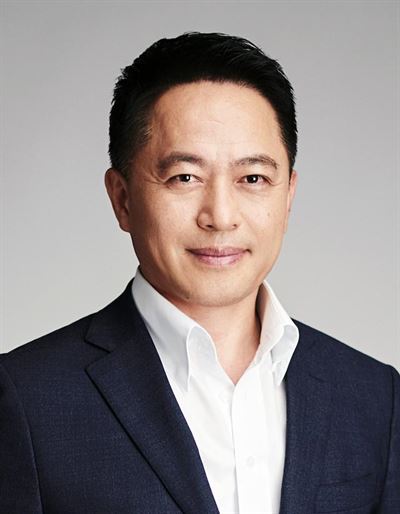
Samsung SDI CEO Choi Yoon-ho
“If we focus on quantitative expansion without a qualitative growth, this may cause irrevocable problems,” Samsung SDI CEO Choi Yoon-ho said last month. “We should pursue qualitative growth, based on thorough precautionary inspections and products that can dominate the market.”
In contrast, the subsidiary of SK Innovation has made aggressive global investments, joining hands with foreign carmakers to expand its presence in North America.
“We surprised the market by receiving an unprecedentedly large amount of orders,” SK on CEO Ji Dong-seop said last month. “We received more orders from global carmakers, securing new clients.”
SK on and Ford established a joint venture named BlueOval SK and agreed last year to invest $11.4 billion to build EV battery factories in Tennessee and Kentucky by 2025. They are considering setting up another joint venture for the European market.
In addition, SK on will invite preliminary tenders this week from global institutional investors, such as Carlyle, KKR and TPG, to attract up to 4 trillion won ($3.3 billion) in investments for increasing the capacity of its battery factories overseas.
LGES has also accelerated efforts to strengthen its partnership with General Motors, through their joint venture named Ultium Cells. Only a week after they announced on Jan. 26 that Ultium Cells will build its third factory in Michigan, the two companies said the joint venture will unveil the location of the fourth factory during the first half of this year.
Although Samsung SDI signed a memorandum of understanding with Stellantis last October to establish a joint venture for the production of battery cells and modules, they have yet to sign a contract for the building of the factory in the U.S.
“We are in talks with another carmaker, but at this moment, it is difficult for us to mention details,” Samsung SDI Senior Vice President Michael Son said Jan. 27 in the company's conference call on its fourth-quarter earnings.
In another apparent effort to gain trust from global carmakers, Samsung SDI also decided late last month to voluntarily recall 1,163 high voltage battery packs installed in around 100 plug-in hybrid vehicles of Ford and Stellantis. The company said it made the decision after discovering welding issues which could cause sudden loss of drive power.