Woowa Bros. befuddled by increasing consumer dissatisfaction with Baemin

Baedal Minjok's food delivery scooters are parked in front of Woowa Brothers offices in Seoul on June 15. Korea Times file
Lawmaker says Baemin is delivery platform with highest percentage of dissatisfied consumers
By Kim Jae-heun
Woowa Brothers, the company that operates the country's largest food delivery app, Baedal Minjok (Baemin), has been receiving the highest percentage of consumer dissatisfaction for its service among local food delivery apps.
Baemin is undoubtedly one of the biggest beneficiaries of the ongoing COVID-19 pandemic, as a pioneer of Korea's food delivery platform service. It owns nearly two-thirds of the market share, followed by Yogiyo and Coupang Eats.
On the one hand, its top position leads Baemin to receive more overall complaints than the other two rivals, because more people use it to order food online.
On the other hand, Woowa Brothers claims that the relatively higher consumer dissatisfaction rate is primarily attributable to the differences in the logistics systems used by the various operators.
“Ninety percent of orders customers make on our platform are delivered by drivers hired directly by restaurants or food delivery firms. People often have the misunderstanding that Baemin drivers deliver food more slowly,” a Woowa Brothers representative said.
“Coupang Eats gets fewer complaints because it only delivers food with its own drivers. We also started a similar service, called Baemin One, in June, and we make fast deliveries with it too,” the representative added. Baemin provides an online platform that customers use to order food and restaurant owners use to receive orders.
“If there is a problem with food quality, that is the restaurant's fault. If the delivery was slow, that is the driver or food delivery company's mistake. People often think we manage all of that. We are just a platform operator,” the representative said.
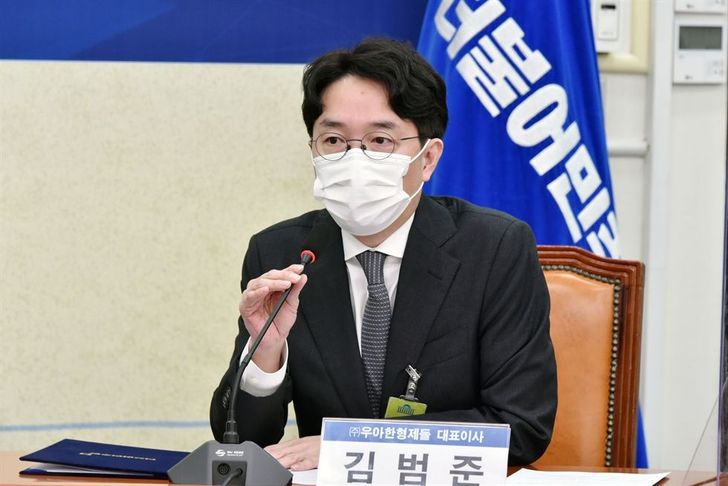
Woowa Brothers CEO Kim Beom-joon speaks at a meeting with representatives of political parties at the National Assembly in Yeouido on Feb. 15. Korea Times file
According to a report from the Korea Consumer Agency (KCA) cited by Rep. Lee Joo-hwan of the conservative main opposition People Power Party, Baemin was picked as the platform with the highest percentage of dissatisfied consumers, compared to other food delivery apps.
Over 58 percent of complaints reported to the KCA in last year were concerning Baemin, followed by Yogiyo with 38.2 percent and Coupang Eats with 2.5 percent.
This year's report filed to the governmental agency in August has even worse findings than the previous year's report. There have already been 272 complaints submitted for Baemin, making up 61.2 percent of the total complaints. Yogiyo has 108 complaints, accounting for 24.3 percent of the total. Coupang Eats received 78 complaints, taking up 14.1 percent.
Rep. Lee says that the soaring number of food delivery service users during the pandemic is the main factor contributing to the increase in consumer dissatisfaction.
The biggest source of consumer dissatisfaction came from Woowa Brother's alleged involvement in breaching the contracts it had signed with local partners.
Woowa Brothers had attempted last year to introduce a new ad fee system, which allegedly would lower commission fees by 1 percentage point to 5.8 percent per order, from the previous 6.8 percent. Baemin said that 52.8 percent of restaurant owners would end up benefiting from this policy, while large businesses would be restricted from monopolizing ad space on the mobile platform.
However, the Korea Federation of Micro Enterprise claimed that the operator was playing tricks on businesses in order to increase the commission fees.
Baemin's profit mainly comes from selling ad space on the platform, as well as from the commission fees it takes when customers order food via its platform.
Other subjects of the complaints included the quality of the service, the unfair treatment of restaurants and the refusal to take responsibility for delivery drivers, as well as unilateral changes to contracts with restaurants after signing.
There have been allegations of food delivery services using their power and leverage to kick restaurants off their platforms for failing to agree to their new fee charging policies. People have seen these incidents as acts of big companies bullying small businesses and the self-employed.
Last year in June, the country's top antitrust regulator, the Korea Fair Trade Commission, fined Delivery Hero Korea, the company that operates food delivery app Yogiyo, 468 million won ($382,000) for taking advantage of its second-place market position between 2013 and 2016 to push a “lowest price policy” on restaurants, in which it required restaurant owners to offer their lowest prices only on Yogiyo.