Hyundai Motor chairman vows to offer new mobility services for humanity
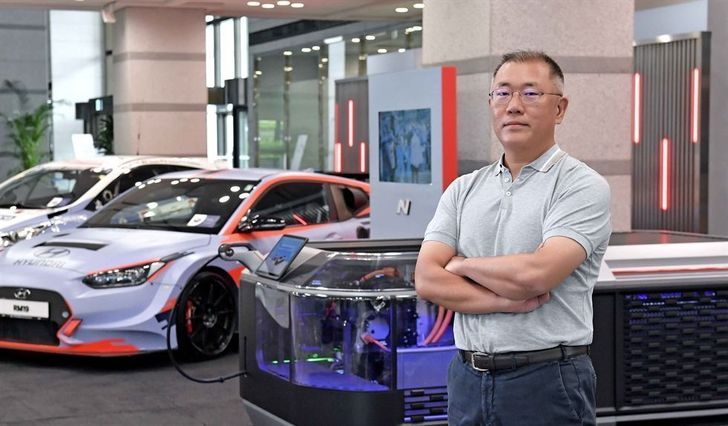
Hyundai Motor Group Chairman Chung Euisun poses with Hyundai Motor's high-performance cars in this photo provided by the group, Monday. Courtesy of Hyundai Motor Group
By Baek Byung-yeul
The reason for Hyundai Motor Group's existence is “to solve what people find the most difficult,” according to Chairman Chung Euisun. He has defined the role of Hyundai as being, “to offer sincere service so that mankind can go where they want without any stress,” in the year since he has taken the helm of the country's largest automotive group, the group said Monday.
The automotive group said that Chung, who marks the first anniversary of his chairmanship on Oct. 14, has emphasized to employees the role of mobility companies to contribute to humanity.
His belief can be seen in his New Year message this year, in which he said, “The mission that all executives and employees of the group should keep unchanged is to realize humanity's dream of safe and free movement and peaceful life together.”
Since becoming chairman, Chung has worked on embodying his vision through developing robotics, urban air mobility (UAM), autonomous driving and hydrogen technology.
In particular, he has emphasized the development of the hydrogen ecosystem, as he thinks this sector is where a solution to global climate change can be found, and that building a hydrogen ecosystem is the responsibility and duty of the current generation.
“Even if there are difficulties in achieving a sustainable future, our generation must play a role to overcome them and make it happen,” Chung said during his visit to the United States in July.
“Hyundai Motor Group's investment in hydrogen is aimed at protecting the future by utilizing all possible technical means,” Chung stressed.

Hyundai Motor Group Chairman Chung Euisun / Courtesy of Hyundai Motor Group
Based on the chairman's vision, Hyundai Motor Group held a “Hydrogen Wave” event in September and unveiled “Hydrogen Vision 2040” so as to make 2040 the first year of hydrogen energy popularization, introducing prototypes for its unmanned, long-distance transportation systems such as a trailer drone and a next-generation fuel cell system.
To contribute to making a sustainable society, Hyundai Motor Group announced in September that Hyundai Motor will be able to achieve carbon neutrality by 2045 and that other affiliates are also pursing joining the RE100 global campaign, aiming to convert 100 percent of their electricity usage into renewable energy.
For the automotive group's robotics vision, Chung decided to acquire U.S.-based robotics company Boston Dynamics as his first large-scale M&A activity since taking the chief position. The group is also developing its own medical exoskeleton wearable robot MEX and artificial intelligence (AI)-based robot DAL-e.
Chung is also laying the foundation for the popularization of UAM, which expands the range of transportation into the sky.
Using hydrogen technology, Hyundai is promoting the development of hydrogen fuel cell powertrains in aviation for their efficiency and mileage. The group is also collaborating with major U.S. cities such as Los Angeles and Singapore to develop take-off and landing sites for UAM vehicles.
For autonomous driving technology, Hyundai Motor introduced the IONIQ 5 Robotaxi, co-developed with Motional, an autonomous driving-specialized joint venture established between Hyundai Motor and Aptive, at the IAA Mobility fair in Germany last month.
Hyundai Motor, Kia and Genesis, the group's carmaker units, are also speeding up their electrification strategies by releasing the IONIQ 5, the EV6 and the GV60.
Under Chung's leadership, Hyundai Motor Group has also been expanding its eco-friendly social contributions, the group said. It is systematizing eco-friendly social contribution projects by region around the world and strengthening its support for social enterprises.
To make it a company that talented people want to join, Chung also focuses on communicating with employees. When he was serving as the executive vice chairman, he had already introduced a flexible work hour system and allowed employees to dress as they wish in an effort to give them more freedom and change the existing rigid organizational culture. As Korea is moving into the “Living with COVID-19” strategy, Chung is also working on improving the company's work-from-home systems.
“Establishing a progressive corporate culture and becoming a company where talented people want to work is more important than winning top place in car sales,” the chairman said.