Space race heats up in Korea's private sector

Gov't takes steps to support entry of more firms
This article is the second in a series of stories highlighting the emergence of the private space industry, in which companies are helping the sector take a major leap. ― ED.
By Yi Whan-woo
Korean companies are capitalizing on their exclusive areas of expertise to join the private-sector space race, with Hanwha Group and Korea Aerospace Industries (KAI) specialized in satellites and rockets, LIG NEx1 in navigation systems and Korean Air in aircraft design and manufacturing.
The country's private space tech industry is still in its nascent stage compared to that of the United States, which has made tangible progress as seen from commercial space flights by SpaceX, Blue Origin and Virgin Galactic.
Korea spent $412 million in space research and development in 2018, according to OECD data. The U.S. topped the list with $26.3 billion, followed by France with $3.42 billion and the United Kingdom with $2.4 billion.
When it comes to the level of technological development, Korea was at 60 percent of the U.S. level in 2019, while China was at 89 percent and Japan at 86 percent, according to data compiled by the U.S. National Technical Information Service (NTIS).
Against this backdrop, the Korean government is lowering barriers for private companies of all sizes to enter the space tech industry. The government is also is seeking to transfer technology and knowhow on projectile development for commercial purposes.
A joint decision in May to terminate U.S. guidelines that have long restricted Korea's development of missiles has allowed individual firms to develop space launch vehicles.
All of these steps are apparently right on track. Morgan Stanley projects the global space industry will generate more than $1 trillion in revenue by 2040, up from $350 billion in 2018.
The Ministry of Trade, Industry and Energy also sees the space tech industry as full of promise and ranks it as the second-most-lucrative business after semiconductors.
“For the private sector to take the initiative in the space race, the government should recognize private companies as investment partners,” said An Hyung-jun, a principal researcher at the Korea Institute of Science and Technology (KIST), a government-affiliated, multi-disciplinary research lab.
The Federation of Korean Industries (FKI), a business lobby group, suggested launching a Korean version of NASA and increasing government spending on the space industry to help more private companies step in.
Hanwha, KAI, LIG Nex1 compete for lead
Hanwha Group is assessed by multiple sources as the most active when it comes to the commercial aerospace business.
The conglomerate in March launched an aerospace taskforce called “Space Hub” led by Kim Dong-kwan, the corporate owner family's heir apparent and the eldest son of group chairman Kim Seung-youn. The taskforce consists of aerospace engineers from affiliates.
Among the affiliates is defense and IT arm Hanwha Systems, which announced a $300 million investment in the London-based satellite communications company OneWeb in August.
The investment allows Hanwha Systems to acquire an 8.8 percent stake in OneWeb that aims to establish a global internet network using a fleet of 648 low-Earth-orbit satellites by next year.
The satellites will provide high-speed and low-latency internet services around the world and could power internet-of-things devices for future services.
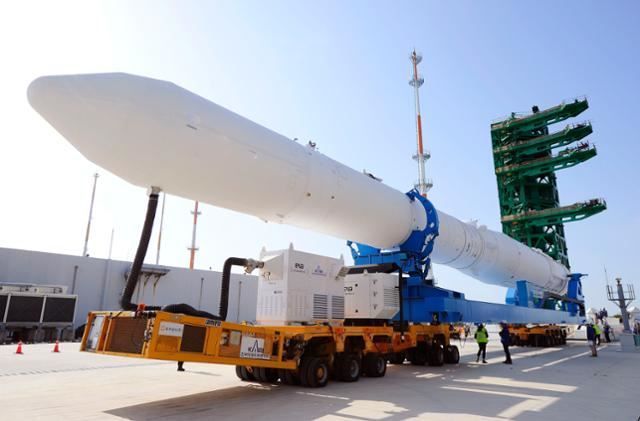
“Nuri,” Korea's first domestically developed space rocket / Korea Times file
Another affiliate, Hanwha Aerospace, participated in the development of “Nuri,” Korea's first domestically developed space rocket that successfully completed a first-stage engine combustion test early this year.
Hanwha Aerospace also acquired a 30 percent stake in satellite manufacturer Satrec Initiative, a domestic firm known for manufacturing small and medium-size Earth observation satellites.
Making satellites as small and light as possible is considered a key to their commercialization.
Hanwha Aerospace is also involved in developing liquid-propellant engines for the Korea Space Launch Vehicle (KSLV) and other components like turbo pumps, valves and thrust vector control systems.
KAI oversees the assembly and system integration of the Nuri rocket with roughly 270,000 parts supplied by more than 300 domestic companies.
KAI signed a contract with SpaceX to develop the “No. 4” next-generation, medium-sized satellite.
KAI plans to send four midsize satellites into orbit by 2025 and SpaceX rocket will carry the No. 4.
The deal with SpaceX took KAI a step closer to developing and launching a 500-kilogram standard satellite platform.
LIG Nex1, a defense contractor, is at the center of the $3 billion Korean Positioning System, a project aimed at building the domestic version of a global positioning system.
The project is critical as Korea plans to start running autonomous flying taxis by 2035, relying on precise satellite navigation that the current GPS can't offer.
If successful, Korea will join the U.S., Russia, Europe, China, India and Japan that have their own satellite networks for high-precision positioning, navigation and timing.
Korean Air, the country's flag carrier, began a feasibility study in cooperation with Seoul National University to use large commercial aircraft for “air launching,” the practice of releasing a rocket, missile, parasite aircraft or other aircraft payload from a mother ship or launch aircraft
The study aims to figure out how to apply core technologies to the project, annual operating costs, and aircraft modification in order to develop an air-launch system with the Boeing 747-400.
Air launch, which happens at an altitude of 12 kilometers, is less affected by weather conditions that often deter ground launches. It is believed to be cost-efficient, as it does not need ground construction and maintenance.