INTERVIEW Rural Development Administration administrator leads digitalization of Korea's agriculture

Rural Development Administration (RDA) Administrator Hur Tae-woong / Courtesy of RDA
'Combining high-technology with agriculture can boost the competence of Korea's agriculture'
By Baek Byung-yeul
In 2020, the Moon Jae-in administration announced its Korean New Deal program in order to boost the country's economy post-COVID-19, as well as create more jobs by investing 160 trillion won ($137 billion) until 2025.
As part of the ambitious plan, the Rural Development Administration (RDA) has been spearheading efforts to digitalize agriculture in an attempt to resolve problems that the country's agricultural sector has been facing, such as the aging of the agricultural workforce.
Due to the decline in the working population, RDA Administrator Hur Tae-woong said that he believes digitalizing the country's commercial agriculture is essential, as the labor-intensive practices of the agricultural industry are facing limitations.
“In 1970, 14.42 million people were engaged in the agricultural industry, accounting for nearly half of the total population, but the figure decreased to 2.31 million in 2020, amounting to only 4.5 percent of the entire population. The decreasing population of farmers, the aging population of rural areas and rapid climate change, such as heat waves, record-breaking rainy seasons, typhoons and cold waves, are problems shaking the foundations of Korea's agricultural industry,” Hur said in a recent email interview with The Korea Times.
Digitalizing agricultural technology
To revitalize the declining industry, the administrator said the agency has tried to combine emerging technologies in the Fourth Industrial Revolution with agriculture.
“The agency is working on lowering barriers to entry into agriculture and developing ways to help farmers make more profit conveniently than before. Our goal is to make the agricultural business a lucrative one so that the industry can attract more young people who want to attempt to make more profit in it,” he said.
What the RDA calls “digital agriculture” means attempting to make agriculture more efficient using emerging technologies such as the Internet of Things (IoT), artificial intelligence (AI), big data and cloud technology, he said.
“Using these technologies, we intend to maximize the convenience, productivity and quality of farming by automating and digitalizing the entire process of agriculture and providing optimal decision-making services,” Hur said.
To help farmers cultivate their crops more efficiently, the RDA established an integrated data system, providing data about 16 kinds of crops, including rice, wheat, beans and corn; four types of livestock, such as “hanwoo” or Korean cattle, dairy cattle, pork and fowl; as well as information on types of soil, weather, livestock diseases and insects.
The RDA is also developing automation technologies in an attempt to increase the convenience and profitability for farmers.
It has developed agricultural observation and automation technology that significantly reduce labor requirements by using technologies such as remote exploration, sensing and autonomous driving. To provide video information on major pests, the agency also plans to develop automatic diagnosis technology based on deep learning technology.
In addition, the RDA is slated to launch an agriculture-purpose satellite in 2025, investing 116.9 billion won to forecast the weather, diseases and insects.
Among its efforts to digitalize agricultural technology, the RDA says that it has been trying to combine high technology with rice farming by developing a self-driving rice seedling planting machine, video and sensor technology-based autonomous paddy irrigation machines and rice seed planting drones.
Individual technologies for digital agriculture, such as direct autonomous driving transplantation applicable to rice farming, video automatic feeding, and drone direct seeding, are being packaged and applied to the field.
“Farmers have been struggling with inconsistent rice harvests due to labor shortages and climate change. To solve this issue, we have developed these machines using various technologies and provided them to farmers in a bundle,” he said adding that these machines help reduce labor costs.
“It costs about 40 million won ($33,969) to attach self-driving equipment onto a rice planting machine. Given that it costs 150,000 won ($127) a day to hire one employee, about 30 days of operation of this equipment can offset the device's costs,” he claimed.
“Also, farmers can check and control the water level of their rice paddies via smartphones when using video and sensor technology-based autonomous padding machines. This tool could potentially drastically reduce the time and labor required to manage rice paddies.” he said.
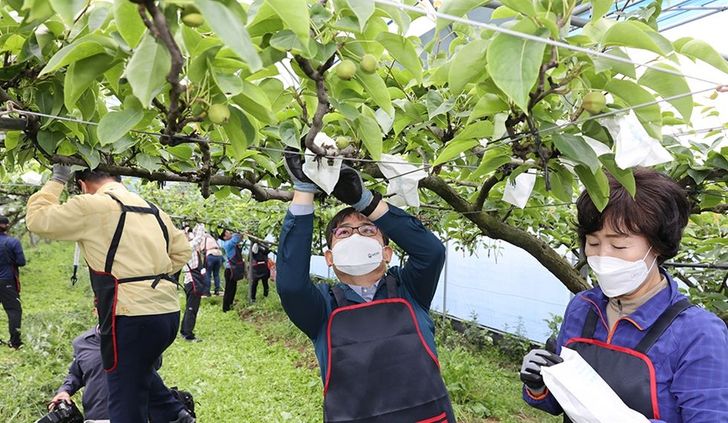
Rural Development Administration (RDA) Hur Tae-woong, center, volunteers to help farmers who grow pears at an orchard in Buan, North Jeolla Province, May 27. Courtesy of the RDA
Achieving carbon neutrality in agriculture
The RDA is also keeping pace with the government's goal of accomplishing net zero emissions by 2050.
In early August, the Presidential Committee on Carbon Neutrality announced action plans about how the country will achieve net zero emissions, as part of the government's effort to join the global movement to fight climate change.
In accordance with the efforts, the RDA has created 12 major projects to realize carbon neutrality in agriculture by 2050. “Our goal can be achieved by developing low-carbon agricultural technologies,” the administrator said.
As a first step, the agency calculated the amount of greenhouse gases emitted in the agricultural sector ― 21.2 million tons of carbon dioxide in 2018.
To respond swiftly to climate change, the RDA is developing a predictive model to evaluate changes in agricultural environments and productivity levels. The agency is also working on developing crops that grow in tropical and subtropical climates, as well as the techniques for how to grow them in Korea, because Korea ― though currently a temperate climate region ― is transforming into a subtropical one due to climate change.
Based in Jeonju, North Jeolla Province, the RDA is a state-run agency that conducts research activities for agriculture and offers education programs to foster experts in the sector. Hur began serving as a RDA administrator on Aug. 15, 2020.
When asked how he felt about what he had done as the chief of the RDA for the past year, Hur said that he, “Has been pushing for the Korean version of the Agricultural New Deal in order to overcome the crisis in both agriculture and in rural areas in general, and to inspire new hope in the industry.”
“Through the Agricultural New Deal, I will do our best to create rural areas where everyone wants to live and to make their lives happy. Also, I will try to make agriculture stand out as a future growth industry,” Hur said.