Biz community, ruling party poles apart over carbon-neutrality goals
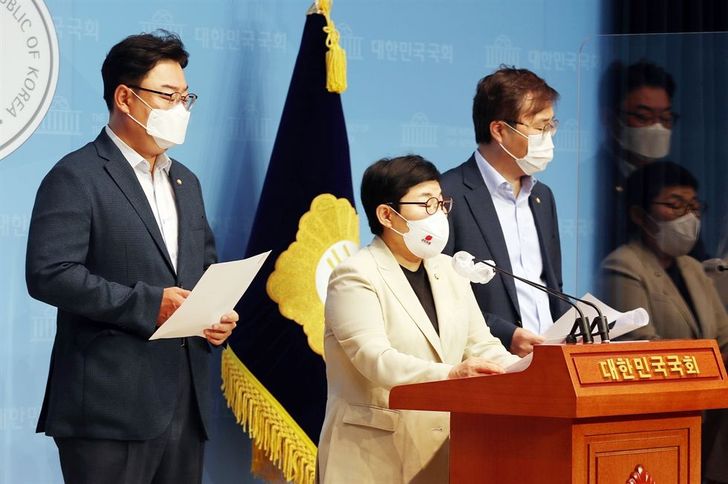
People Power Party Rep. Lim Lee-ja appears with lawmakers of the same party during a press conference at the National Assembly, criticizing the ruling Democratic Party of Korea lawmakers' decision to pass a bill to reduce carbon emissions by 35 percent for 2030, Thursday. Yonhap
By Baek Byung-yeul
The business community and the liberal ruling Democratic Party of Korea (DPK) remain poles apart on their path to reach the global goal of carbon neutrality, with the former openly speaking against the latter's move to pass a bill aimed at tightening the regulation on greenhouse gas emissions.
The National Assembly's Environment and Labor Committee on Thursday endorsed a bill that seeks to cut emissions in 2030 by 35 percent or more from 2018 levels.
The move is to help accelerate President Moon Jae-in's Green New Deal initiative that has the goal of cutting greenhouse gas emissions in 2030 by 24.4 percent from 2017 levels.
The bill, backed by the DPK, additionally requires endorsements from the Legislation and Judiciary Committee and the National Assembly's plenary session later this month to take effect. The DPK holds more than half of the 300 seats in the Assembly.
Korea's amount of carbon emissions reached its peak in 2018 at 72.8 million tons and has been on a downward trend since then.
Many companies that are not fully prepared to adjust to the strengthening environmental regulations, especially in the energy, steel and transportation sectors, criticized the ruling party for its “hasty decision” without sufficient discussion with related industries.
They argued a 35 percent goal is not feasible, although they agreed with the ruling party and the Moon government on the need to cut emissions to better cope with climate change.
Yoo Hwan-ik, chief economist of the Federation of Korean Industries (FKI), said the bill could severely hinder the competitiveness of the nation's industries, which are centered on manufacturing.
"Considering the impact of the legislation of the greenhouse gas reduction goal on the Korean economy, the bill was passed without sufficient discussion by the legislative committee. The act stipulated that greenhouse gas emissions should be reduced by more than 35 percent compared to 2018, but it is feared to place too much of a burden on the national economy,” Yoo said.
“At a time when industrial consensus has not yet been finalized, legislating the reduction target could adversely affect the discussion for a reasonable goal-setting. We ask for careful review of the act so that the reduction goal can be established reasonably according to the nation's economic conditions.”
If the reduction target is set to 35 percent, Korea will have to eliminate a total of 240.21 million tons of carbon emissions by 2030.
“The bill has been pushed too quickly. It should have been done through expert surveys from various industrial groups,” a manufacturing industry official said. “Even if companies try to significantly increase the proportion of renewable energy use such as solar energy, the carbon emissions reductions are so large and expensive.”