Korea's carbon neutrality plans considered both overly ambitious and not strong enough
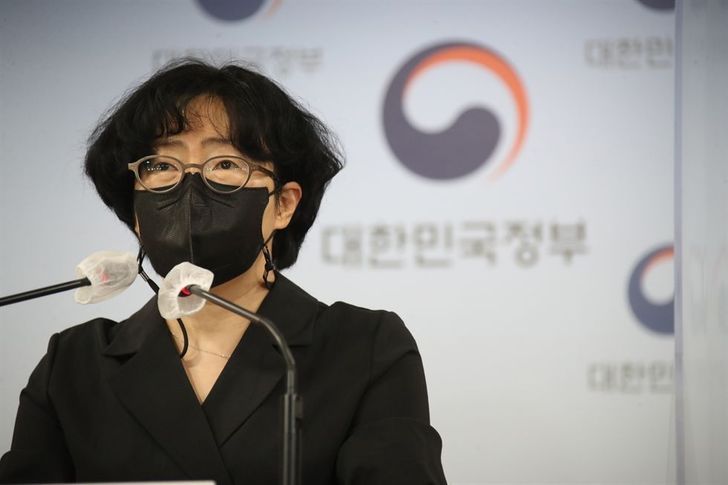
Yun Sun-jin, co-chairperson of the presidential committee on carbon neutrality, announces three plans to achieve net-zero emissions by 2050 at the government complex in central Seoul, last week. Yonhap
By Baek Byung-yeul
The business circle and environmental advocates are casting doubts over both the feasibility and thoroughness of the government's plans, unveiled last week, to achieve net zero emissions by 2050.
Business representatives argue that the drastic plan will reduce the number of jobs and undermine the competitiveness of the nation's industries, which are centered on manufacturing. Meanwhile, environmental groups say the plans come up short in realizing full carbon neutrality.
The Presidential Committee on Carbon Neutrality announced three plans to achieve net zero emissions, Thursday, as part of the government's effort to join global efforts to fight climate change.
The committee said the three plans are differentiated by the rate of eco-friendly technology adoption.
The first aims to reduce greenhouse gas emissions by 96.3 percent by continuing to rely on pre-existing resources, such as coal and liquefied natural gas (LNG), while the second aims to suspend coal development and eliminate greenhouse gas emissions by 97.3 percent.
The third is to reduce greenhouse gas emissions 100 percent by replacing coal and LNG development with green hydrogen, referring to the production of hydrogen from renewable energy sources, such as wind, solar, geothermal or biomass.
"We have established a vision for a carbon neutral society that is safe and sustainable, and presented a draft scenario based on five principles: responsibility, inclusion, fairness, rationality and innovation,” Yun Sun-jin, the co-chairman of the committee and a professor at the Seoul National University Graduate School of Environmental Studies, said.
However, the Federation of Korea Industries (FKI), the country's business lobby group, expressed its concerns, saying, “The committee set the carbon emission reduction goal too high.”
“In all three of the scenarios, the industry sector should cut about 80 percent of its 2018 level emissions by 2050. If we set unreasonable goals in Korea, which has a manufacturing-oriented industrial structure, we are concerned about job losses and a decline in the international competitiveness of manufactured products," the FKI said in a statement.
The FKI also pointed out that the draft doesn't include the use of nuclear power generation. “Nuclear power plants are able to provide stable power without emitting greenhouse gases. As the United States, Japan and other countries also use nuclear power as a means of realizing carbon neutrality, Korea should include measures to expand nuclear power plants in its plan.”
gettyimagesbank
The committee's plans were also criticized by civic groups, who said that the first and second scenarios should not be referred to as “carbon neutral,” as the plans still allow greenhouse gas emissions.
“The three scenarios proposed by the committee are projections based on very limited preconditions and their means of implementation is also unclear,” the Korea Federation for Environmental Movements (KFEM) said in a statement.
“The announcement, under the name of 'carbon neutral scenarios' for the first and second plans that are expected to fail to achieve carbon neutrality by allowing the continued emission of greenhouse gases, shows insufficient work on the part of the carbon neutral committee. In particular, it is embarrassing to refer to the low conversion rate of eco-friendly cars in the transportation sector and the failure to eliminate the use of coal and fossil fuels in the electric power sector as part of carbon neutral scenarios,” KFEM added.
The committee is scheduled to announce the final version of its 2050 carbon neutrality plan in October. Before coming out with the final draft, the committee will listen to the opinions of various groups, including those from the industrial sector, civic groups and scholars.
Given the fact that the committee has faced setbacks from both civic groups and industry concerning the three scenarios, there is the chance that the organization will come up with a new plan. The final version, made by gathering these opinions, will be announced to the international community at the 26th UN Climate Change Conference of the Parties in November.