Test Drive Kia aims for success with new K9 sedan

The new Kia K9 / Courtesy of Kia Corp.
By Kim Hyun-bin
Kia Corp. has come out with a facelift version of its flagship K9 luxury sedan featuring a sportier and “younger” image.
The K9 is better known in Korea as “the chairman's car” as it is the go to model favored by Hyundai Motor Group Honorary Chairman Chung Mong-koo.
“The new K9 is Kia's flagship model that is not only a means of transportation, but will also offer inspiration to drivers,” A Kia official said.
The car is the second generation of the flagship sedan featuring partial updates in software and the exterior of the vehicle marking the first facelift since April 2018. Not much seems to have changed in the exterior other than minor revisions to add to the luxurious image, compared to its predecessor.
The facelift includes a larger radiator grill that gives a more dynamic vibe. The new Kia emblem also adds to the more luxurious and sporty feel, better appealing to drivers even in their mid-30s to 40s.
The premium sedan is 1.92 meters in width, 1.5 meters in height and has a wheelbase of 3.1 meters; longer than the Genesis G80 and 20mm longer than BMW's flagship 7 Series.
The Korea Times had the opportunity to test drive the new K9 3.8-liter, V6 gasoline all-wheel drive (AWD) Masters model with eight gears. There were more changes in terms of the technical features, offering a predictive gear-shift system (PGS) which provides driver assistance through sensors and cameras. That function makes the driving experience more convenient and comfortable when making turns or on highways as well as raising fuel efficiency. While the multi-collision braking system and electronic control suspensions aims to increase safety, Kia said.
?
The eye-catching factor once inside the vehicle is the luxurious feel of the interior, plush with quilted seats as well as a 14.5-inch center display. The new K9 also features a fingerprint recognition system and Ergo motion seats that provide an upgraded level of comfort throughout the duration of the ride. The center control that recognizes handwriting is also a noteworthy function giving it a more futuristic feel.
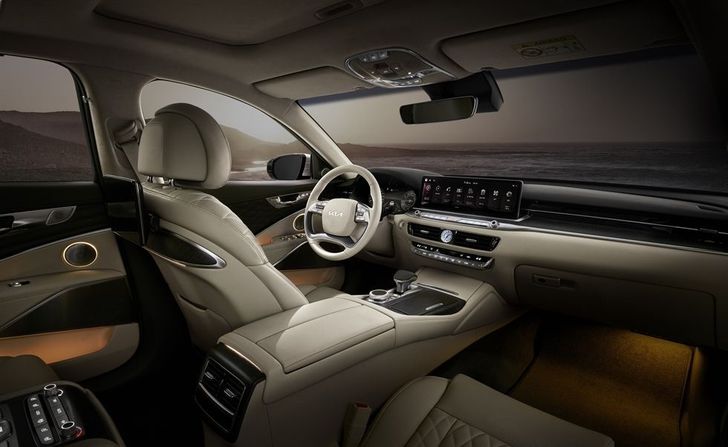
The interior of the new K9 / Courtesy of Kia Corp.
Despite the changes, one thing came to mind right off the bat ― the interior gave a strikingly similar vibe to that of the Genesis G80. Although Hyundai Motor and Kia Corp. are both affiliates of Hyundai Motor Group, that does not make it right for the interior to be so similar, although it might be cost-effective. The structure and the placement of the buttons and overall ambiance of the front and back placements had quite similar traits as well.
Putting the similarities aside, the test drive started off from the Walker Hill Hotel in southeastern Seoul to Pocheon, Gyeonggi Province around an 80km roundtrip. The V6 engine has a maximum 315 horsepower and 40.5㎏f·m of torque that ensure a speedy acceleration reminiscent of competing sports sedans. The turns were quite smooth giving a comfortable driving experience.
The open highway gave the urge to test the Kia K9's key technology: the PGS system. When entering the highway, the PGS system automatically changes from comfort to sports mode with the engine swiftly adapting to the changes. When encountering curvy roads, the PGS shows a sign that reads, “entering curvy road,” on the navigation system linked to the PGS. When encountering speed cameras, the sedan automatically reduces speed, which will come in handy for drivers who often get slapped with a speeding fine.
The new version of highway assistance is also satisfying as it maintains a certain distance from the car in front and recognizes oncoming traffic from the back, while making lane changes easier.
The new K9 is the second generation with a partial facelift from the previous model. The first generation was launched in 2012 and Kia sold 7,500 of them, which became the flagship model in the automaker's line-up. However, K9 sales failed to exceed 5,000 for the next five years.
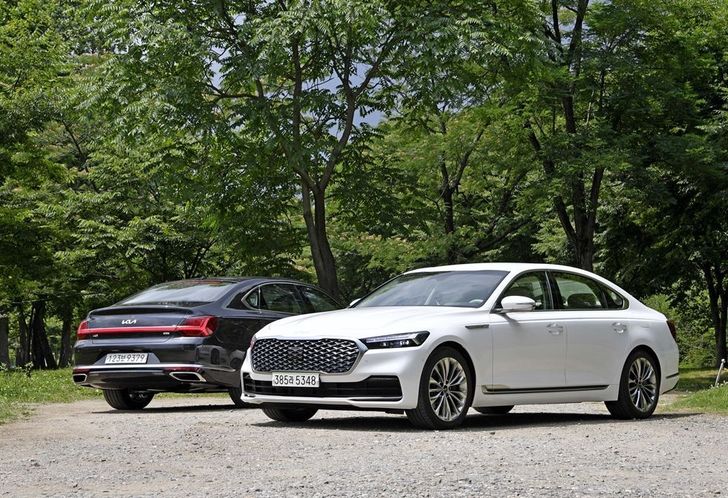
Kia K9s in black and white / Courtesy of Kia Corp.
However, that changed with the release of the second generation K9 model which tapped into demand for the Genesis G80 3.8-liter model. With the success, Kia sold 11,843 K9s in 2018 and over 18,000 in 2019, which led to the discontinuation of the G80 3.8-liter model.
In 2020, Hyundai introduced a stronger 3.5-liter turbo version of the G80 lineup that led to a reduction of K9 sales to 7,831 last year. But Kia hopes to take back some of the loss in demand with the new K9 3.8-liter gasoline and 3.3-liter gasoline turbo models.
When compared to its predecessor, the new K9 has become younger and more sophisticated in design along with newly-added technologies that enhance the driving experience. The price tag for the new K9 starts at 56.9 million won for the 3.8-liter Gasoline Platinum model and 63.4 million won for the 3.3-liter Gasoline Turbo Platinum model, which is cost-effective compared to other large luxury sedans out on the market and much cheaper than foreign luxury brands that are equipped with the latest gadgetry and technologies that Kia's new K9 matches.