Gov't to discuss easing gaming curbs on children

This screen capture from the website of “Minecraft” shows a notice that those under the age of 19 in South Korea are not allowed to purchase and play the Java edition of the game. Captured from Minecraft website
Controversy growing as 'Minecraft' receives R-rating for Korean users
By Jun Ji-hye
A debate is being reignited over Korea's so-called shutdown law that blocks children under the age of 16 from playing online games after midnight, after a version of “Minecraft,” one of the world's bestselling games, effectively became unavailable for children here due to the controversial act.
The Ministry of Gender Equality and Family, which led the enforcement of the law, said Wednesday that it will discuss measures to improve the regulation, acknowledging that the gaming environment is changing rapidly.
“A variety of questions have been raised about the law, with some having called its effectiveness into question,” a ministry official said. “We acknowledge that the ministry has failed to respond to changes in the gaming environment, though we have made several attempts.”
The act, also called the “Cinderella law,” was introduced in 2011 to block children under the age of 16 from playing online games between midnight and 6 a.m., in a bid to guarantee their sleeping hours and health.
It required operators of games to take additional technical measures to verify users' age and restrict young gamers' access during those hours.
The law, however, has been drawing skepticism for a long time over its effectiveness, as children could still access games after midnight if they used their parents' or other adults' IDs. The controversy over its effectiveness grew, as the popularity of mobile games exploded over the past decade. Mobile games are not subject to the law which was enacted when PC games were more common.
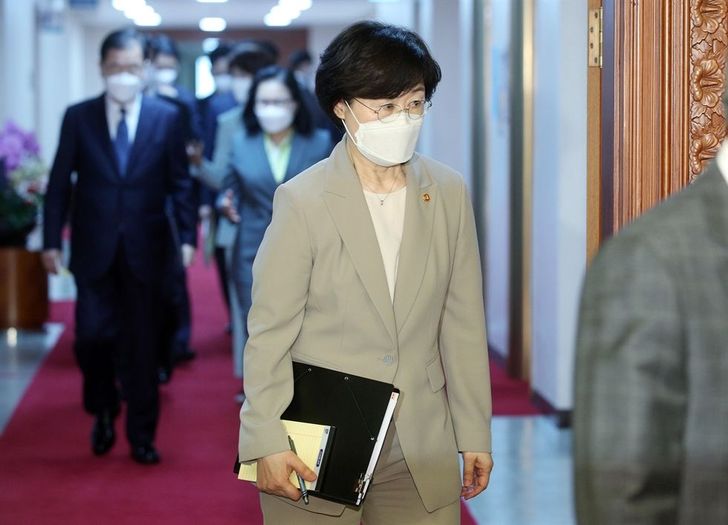
Gender Equality and Family Minister Chung Young-ai walks down a hallway at the Government Complex Seoul to participate in a Cabinet meeting, April 27. Korea Times photo by Hong In-ki
An issue involving “Minecraft” stirred up controversy, Monday, when the operator of the game, Microsoft, posted on the game's website: “For players in South Korea, you must be 19 years of age or older to purchase and play the Java edition of Minecraft.”
This decision came as Microsoft, which acquired “Minecraft” developer Mojang Studios in 2014, has been working to migrate Mojang accounts to Microsoft ones since earlier this year.
In this process, the U.S. tech giant decided to completely block access to people under the age of 19 in Korea to follow the country's rules, rather than taking additional technical measures to check players' age. From the point of view of Microsoft, which offers its services to global users, it would not make sense to take additional technical measures only for Korea.
“Minecraft,” an online block building game which was rated for over 12 years old in Korea, has been very popular among children here. The game has also been used for educational purposes at some schools.
As Microsoft's latest decision, which apparently stemmed from Korea's shutdown law, thwarted young players' right to enjoy the game, nine groups of “Minecraft” users issued a joint statement calling for the law to be abolished.
Some politicians have also joined the criticism. Former Prime Minister Chung Sye-kyun of the ruling Democratic Party of Korea (DPK), who recently declared his presidential bid, said, “Minecraft, which has been played by more than 150 million users around the world, faced the shutdown regulations in Korea. The family ministry's apathetic attitude has put the brakes on the development of the country's game industry.”
Rep. Ha Tae-keung of the main opposition People Power Party said, “It is the family ministry, not a game, that should be shut down.”
In response to the criticism, the ministry said it will cooperate in National Assembly discussions, as several bills to abolish or improve the law have been submitted.
Rep. Jeon Yong-gi of the DPK submitted a bill to revise the Youth Protection Act to abolish the law, while Rep. Kang Hoon-sik, also from the DPK, submitted a bill to maintain the system but allow children to be exempted from the application of the game curfew when there is a request from their parents to game operators.
“We will also hold a meeting with officials from game companies, experts and government officials to discuss better measures to prevent children from playing games excessively,” the ministry official said.