Korea to enact special law for battery, chip industries

Industry Minister Moon Sung-wook, left, is briefed by Samsung SDI CEO Jun Young-hyun on the company's battery-manufacturing facility in Ulsan, Monday. Courtesy of Ministry of Trade, Industry and Energy
Korea commits 'full assistance' to battery industry
By Baek Byung-yeul
The government has pledged to support the domestic secondary battery industry to grow it into a flagship export item, with moves to help develop new technologies, nurture local firms and foster education for people involved in the industry.
Minister of Trade Industry and Energy Moon Sung-wook held a meeting Monday with executives from domestic battery companies at Samsung SDI's manufacturing plant in the southeastern industrial city of Ulsan.
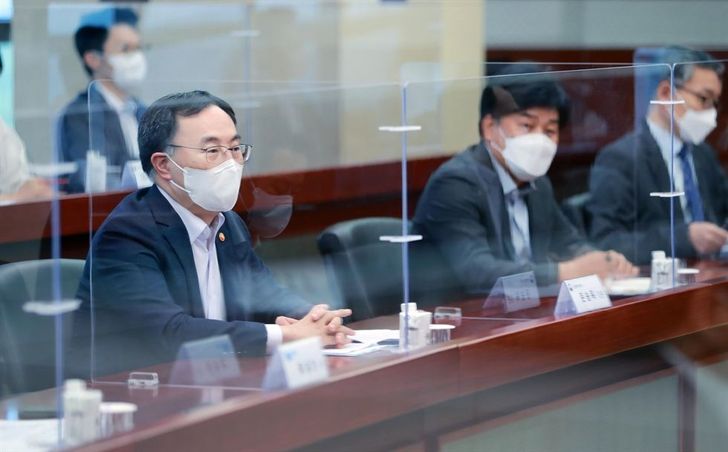
Minister of Trade Industry and Energy Moon Sung-wook speaks during a meeting with executives from local battery companies at Samsung SDI's Ulsan plant, Monday. Courtesy of Ministry of Trade, Industry and Energy
“The administration will push for the enactment of a special law to support core industries such as secondary batteries and semiconductors in order to stabilize supply chains and secure future competitiveness,” Moon told the attendees at the start of the meeting, according to press pool reports. “Korea will boldly pursue development of battery technology, fostering major companies and training professionals in the industry.”
The meeting brought together executives from Samsung SDI, EcoPro BM, Chunbo, Isu Chemical, Iljin Materials and Dong-Il Aluminum.
Samsung SDI, one of the top three battery makers in the country, has been manufacturing various kinds of batteries for electric cars, energy storage systems (ESS), smartphones, electric scooters and electric tools. The Samsung Group affiliate is also taking a lead in the industry by actively pursuing the development of new technologies.
Company executives participating in the meeting shared their thoughts on a development strategy for the battery industry. “At the meeting, participants agreed that policy support for next-generation technology development, personnel training, cooperating between public institutions and private firms and cross-company cooperation are needed,” the ministry said.
The government is scheduled to announce what it calls the “K-battery” strategy, this week. In May, the country unveiled its “K-semiconductor” strategy to establish the world's largest chip supply chain here by 2030 in cooperation with Samsung Electronics and SK Hynix, as well as their suppliers.
LG Energy Solution (LGES), Samsung SDI and SK Innovation (SKI) ― are set to update their investment plans that will include specifics for facility expansion to meet rising demand for battery-embedded products such as electric vehicles. In addition, the government plans to assist moves by companies wishing to hire experienced personnel and offer greater tax benefits.
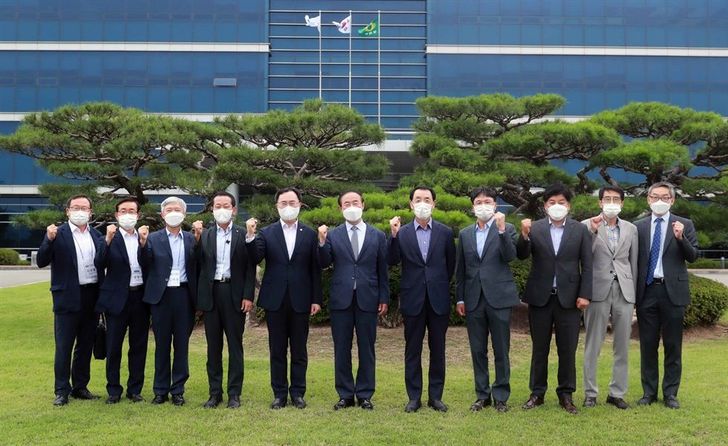
Industry Minister Moon Sung-wook, fifth from left, poses with Samsung SDI CEO Jun Young-hyun, sixth from left, and other top battery industry officials at the company's plant in Ulsan, Monday. Courtesy of Ministry of Trade, Industry and Energy
After having a meeting with the executives, the minister met for tea with students from the Ulsan National Institute of Science and Technology (UNIST), a state-run research university, to encourage their research efforts.
“The demand for professionals in the secondary battery business is increasing quantitatively and qualitatively,” the minister told the students. Since its foundation in 2009, UNIST has been focusing on the development of projects relevant to the fine-tuning of battery research.
“The value of battery professionals with theory and practical capabilities will increase further,” Moon added.