SsangYong restructuring plan moves ahead with labor backing

Actress Lee Si-young poses with SsangYong Motor's new Rexton Sports pickup truck in this photo provided by the company, April 5. Courtesy of SsangYong Motor
By Baek Byung-yeul, Kim Yoo-chul
SsangYong Motor's massive restructuring drive is gathering upward momentum as its labor union said it would accept creditors-suggested cost-cutting proposals to save the company from total devastation.
“SsangYong's labor union is prepared to share the burden and we are also ready to embrace larger-than-expected restructuring if there's a guarantee for financial assistance,” a representative of SsangYong Motor's labor union said, Tuesday.
“To find a new investor, the union of SsangYong Motor had implemented a preemptive rescue plan which included freezing wages to save 120 billion won. Also, to help the company secure a stable supply of car components, we agreed to a 50-percent wage cut from January to April this year,” its union representative Jung Il-kwon said.
“Though the company was placed under court receivership after a potential buyer didn't submit a letter of intent, we will not be perturbed and will actively cooperate with stakeholders for the resale of the company,” Jung further noted, adding SsangYong should produce a restructuring plan that could retain the current employment level.
The ailing Korean automaker has made plans to cut the number of executives by 30 percent after being forced back into court receivership.
Local civic groups in Pyeongtaek, where SsangYong's key plants are located, launched a committee hoping for an early normalization of the automaker. “We are sorry to interested parties affected by our decision to file for receivership and thank you for your great support to us. We will try to get the company back on track as early as possible through close cooperation with the labor union,” SsangYong said in a statement.
Concerns are that despite its suggested revival plans, chances are slim for the cash-strapped company to attract a new buyer, because it lacks the ability to produce eco-friendly cars such as electric vehicles, said market analysts.
“SsangYong is a carmaker that manufactures diesel-powered SUVs. There was a time when the company boasted a technological edge and manufacturing knowhow compared to carmakers in emerging countries, but it doesn't have any competitive features left to appeal to potential buyers,” Kim Pil-soo, an automotive technology professor at Daelim University College, said.
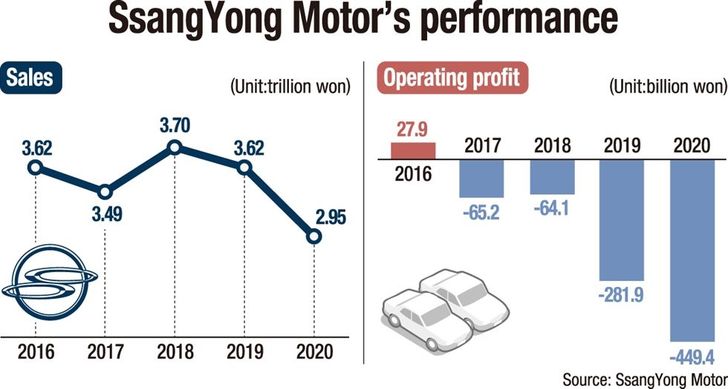
Seoul Bankruptcy Court recently approved a debt-rescheduling process for the company, ordering the carmaker to submit a rehabilitation plan by July 1, when the court will decide whether it makes more financial sense to keep it afloat or liquidate it.
This is the second time SsangYong has been put under court receivership. The first time was in 2009 when SAIC Motor of China, which was the majority stakeholder at the time, relinquished control of the carmaker.
In 2011, India's Mahindra & Mahindra acquired 70 percent of the shares of SsangYong Motor for 523 billion won. The Indian company now holds a 74.65 percent stake.
But the automaker has been struggling with financial problems after the Indian company revealed it would not inject fresh capital into the firm but would relinquish its status as major shareholder. The bankruptcy court approved SsangYong's receivership after a potential buyer, HAAH Automotive, failed to submit a letter of intent to acquire the ailing automaker by March 31.
Industry watchers believe it will make more financial sense to liquidate SsangYong Motor than to keep it afloat. The ailing automaker has suffered a cumulative operating loss of more than 1 trillion won. But industry watchers also point out that the matter has now become more political than ever, considering the fact that the automaker's subcontractors alone employ 4,900 workers.