SsangYong's prepackaged bankruptcy plan shows no progress
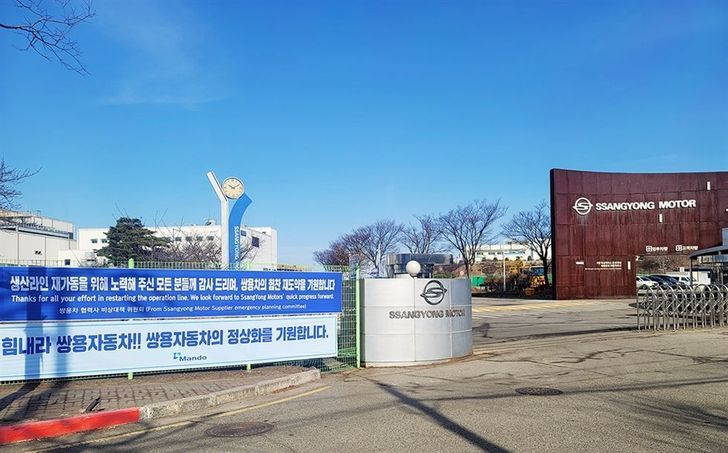
Banners rooting for SsangYong Motor's quick recovery from financial difficulties are displayed at the carmaker's plant in Pyeongtaek, Gyeonggi Province, in this photo released on March 2. Courtesy of SsangYong Motor
By Nam Hyun-woo
SsangYong Motor's bid to file for a prepackaged bankruptcy is showing no progress, as its negotiation with new investor HAAH Automotive Holdings is being stalled amid the looming deadline to submit a restructuring plan to a local bankruptcy court.
According to industry officials, Sunday, SsangYong Motor and HAAH have not reached an agreement over the latter's investment into the former, despite SsangYong's request for HAAH to express its intention to invest by Saturday.
SsangYong has promised to submit documents regarding HAAH's investment to the Seoul Bankruptcy Court by the end of this month, as part of its prepackaged bankruptcy. Prepackaged bankruptcy is a procedure in which a restructuring plan is agreed with creditors before a company declares its bankruptcy and goes into court receivership. SsangYong needs agreements from half of its creditors.
After announcing its plan to file for a prepackaged bankruptcy in February, SsangYong Motor and its largest shareholder Mahindra & Mahindra have been going through necessary processes.
Recently, the Reserve Bank of India approved Mahindra to reduce its stake in SsangYong Motor to 25 percent from 75 percent through capital reduction, which will allow HAAH to become the owner of SsangYong Motor by purchasing new shares at a cheaper price. Through this, the restructuring plan seeks to draw $250 million from HAAH in return for giving the U.S. car distributor a 51 percent stake in SsangYong.
However, HAAH has yet to announce its clear intention to join this program, apparently because of SsangYong's 370 billion won ($327.4 million) of bonds and a potential dispute with its union over payroll and employee headcount.
SsangYong's outstanding debts total 1.86 trillion won, some of which will be written off when the company goes into receivership. However, the 370 billion won worth of bonds are not subject to the remission because they were issued for the purpose of SsangYong's rehabilitation, meaning HAAH has to shoulder this cost.
Due to the additional costs, HAAH is demanding SsangYong's main creditor, Korea Development Bank (KDB), extend financial aid worth $250 million to SsangYong. The state-run KDB is refusing to do so, saying stakeholders' agreement and SsangYong's serious restructuring should come first. KDB does not have a stake in SsangYong.
Labor issues are also a setback for HAAH. Unlike other carmakers in Korea, SsangYong Motor's union has not been staging strikes or other union-wide actions against management since 2009. The union also agreed to freeze employees' wages last year to assist the company's efforts to get over its financial difficulties.
Against this backdrop, a restructuring plan involving changes in payroll and other working conditions may trigger a large-scale dispute. The union has already expressed its opposition to KDB's demand for the union to have collective bargaining negotiations once in three years.
“Given SsangYong's sales trajectory and current market competitiveness, there is no reason for KDB to extend new loans or other aid,” a car company official said. “With Mahindra and HAAH both remaining reluctant to spend more money on SsangYong, the company seems to have no choice but to improve its cost structure through restructuring and then request HAAH or KDB spend some more.”

SsangYong Motor's Tivoli / Courtesy of SsangYong Motor