LGES seeks to expand battery investment in US amid feud with SKI
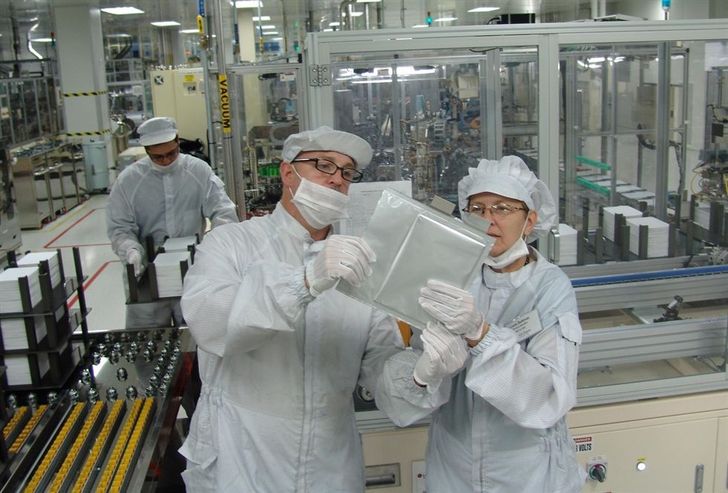
LG Energy Solution employees hold the company's batteries in its Michigan factory in the U.S. Courtesy of LG Energy Solution
Georgia governor asks President Biden to overturn USITC decision against SKI
By Baek Byung-yeul
With LG Energy Solution (LGES) and SK Innovation (SKI) still not able to settle their battery dispute even after a United States International Trade Commission (USITC) ruling, LG has expressed its intention to expand battery investment in the U.S. state of Georgia, while SK is hoping for President Joe Biden to veto the ruling.
In February, the USITC gave a final ruling in favor of LGES, which had accused SKI of intellectual property theft related to electric vehicle (EV) battery technology. The commission also issued a 10-year exclusion order banning SK from importing some batteries into the U.S.
SKI is counting on President Biden to exercise his veto power on the ruling, banking on its massive investment plan in a battery-manufacturing factory in the state of Georgia, which also could bring large-scale job creation. The U.S. president has until April 11 to review the ruling and alter or block the decision.
On a related note, Georgia Governor Brian Kemp asked President Biden to overturn the USITC's decision against SKI, Friday (local time), in a bid to save thousands of jobs in the state. SKI is constructing its first plant there with an aim to start mass production in 2022. It is also building a second plant which is expected to be in full operation in 2023.
"The livelihoods of thousands of Georgians are now in your hands,” Kemp said in a letter to Biden.
As SKI could be cornered to scrap its investment plan in Georgia, if the USITC's ruling is finalized, the governor added, “It is contrary to the public interest and will seriously jeopardize your administration's environmental and economic goals.”
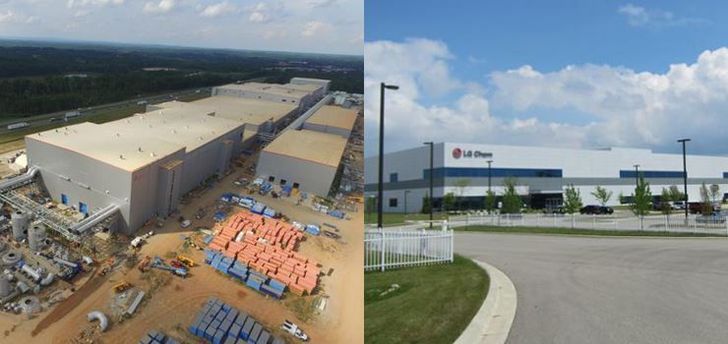
The construction site of SK Innovation's battery plant in the U.S. state of Georgia, left, and LG Energy Solution's battery plant in Michigan. Courtesy of each company
While SKI is increasingly trying to influence political sides to favor its interests, LGES has made an offer to some Georgia officials that the company could build its own battery plant factory in the state if SKI cannot proceed with its investment plan there.
According to a report from a Georgia newspaper, the Atlanta Journal-Constitution, LGES CEO Kim Jong-hyun wrote a letter to Democratic U.S. Senator Raphael Warnock on March 10 saying LG “is prepared to do whatever we can to help the people and workers of Georgia.”
The CEO added in the letter that, if an outside investor acquires the SK plant, LGES could partner with it to run the plant. “Multiple investors and manufacturers … will be interested in the Commerce plant due to increased demand for electric vehicle batteries,” Kim said.
Regarding the CEO's remark, an LGES official said the letter was “intended to clearly address that the current situation has been caused by SK's misappropriation of our trade secrets and to address concerns about jobs in Georgia.”
In addition, LGES is set to increase investment in the U.S. as the company announced on Friday that it will invest 5 trillion won ($4.4 billion) to build at least two battery-making plants there and raise its U.S. production capacity to 75 gigawatt hours.
LGES has been operating a battery plant in Michigan with an annual capacity of 5 gigawatt hours, and is currently building a 35-gigawatt-hour plant in Ohio with General Motors. The company added it will shortlist at least two candidate sites for the forthcoming new battery plants in the U.S. within the first half of 2021.
Against the CEO's remark, an SK spokesperson said in an emailed statement that “it is simply impossible for someone to acquire an EV battery manufacturing facility and run it to produce batteries acceptable to a major car company.”
The spokesperson added, “LG's monopolization of the U.S. battery supply chain will only set the U.S. further back in its efforts to catch up with China.”