New fair trade rule forces Hyundai to restructure governance
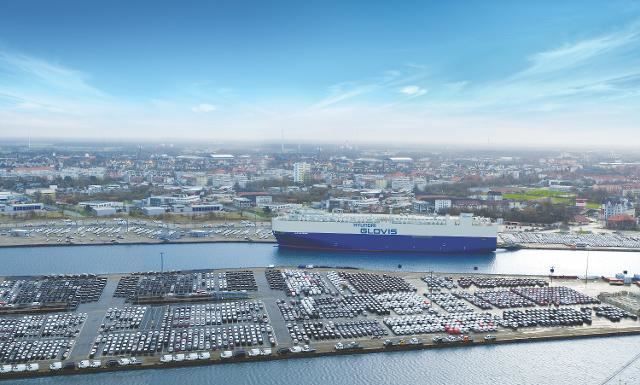
A vehicle carrier operated by Hyundai Glovis is docked in the German port of Bremerhaven in this file photo. Courtesy of Hyundai Glovis
By Nam Hyun-woo
Hyundai Motor Group is under growing pressure to revamp its shareholding structure between units after revisions to Korea's Fair Trade Act strengthening regulations on intra-affiliate trading passed the National Assembly.
This is because the new rule forces the group's owner family to unload a significant amount of shares in a unit which plays a key role in the automotive giant's shareholding structure.
Industry officials said Friday the new regulations will urge the group to quicken its efforts to come up with a new shareholding structure centered on Chairman Chung Euisun, who took the position in October.
The National Assembly passed a number of revisions to the Fair Trade Act on Wednesday. The revisions place a 20 percent cap on owner families' stakes in a company benefiting from inter-affiliate trading. Currently, the cap is 30 percent for listed company, but the revision will tighten it to 20 percent from January 2022.
Companies in which the owners' stake surpasses the cap will be subject to the existing rules, which regulate intra-affiliate trading worth more than 20 billion won or 12 percent of annual sales of those companies.
This is anticipated to directly affect Hyundai Motor Group's logistics unit, Hyundai Glovis.
Among the group's owner family, Chairman Chung and his father Chung Mong-koo hold 23.39 percent and 6.71 percent stakes in Hyundai Glovis. When combined, their shares reach 29.99 percent, barely meeting the current regulation.
When revisions take effect in 2022, the two Chungs either have to unload about 10 percent of their combined stake in Glovis or the logistics company has to lower its intra-affiliate trading significantly.
According to its regulatory filing, Hyundai Glovis posted 18.27 trillion won in sales, and revenue from Hyundai Motor and Kia Motors each accounted for 35.45 percent and 23.75 percent, respectively. This means that it is almost impossible for the company to lower its intra-affiliate trading enough to meet the regulation, thus the owner family has to sell off their stakes.
This is not the first time that the Chung family has had to unload their stakes in Hyundai Glovis. In 2015, the two Chungs sold a 13.39 percent stake in Hyundai Glovis to lower their holdings from 43.39 percent to the current 29.99 percent, following a previous revision to the Fair Trade Act.
Chairman Chung's stake in Hyundai Glovis has widely been considered as the key in restructuring Hyundai Motor Group's shareholding structure.
The group has four complex cross-shareholding loops, and component unit Hyundai Mobis is serving as a de facto holding firm in those loops. To effectively control Hyundai Motor Group and meet the government's demands to break those loops, Chung needs to increase his stake in Hyundai Mobis, but he only has a 0.32 percent stake in the company.
To address these, the group had a botched attempt in 2018 to spin off Hyundai Mobis' module and after-service divisions and merge them with Hyundai Glovis by swapping stocks, thus improving Glovis' market value. The plan faced strong opposition from a number of investors who questioned the stake swap ratio was overvaluing Glovis.
“Given the previous experience, Hyundai Motor Group must know that improving Glovis' value is important,” an industry official said. “If the owner family unloads 10 percent stake to the market, a drop in Glovis' share price will likely follow. This comes as a pressure for the group to be hurry in coming up with shareholding structure plan before the revision to take effect and the owner family are obliged to sell off their stakes.”
Hyundai Motor Group refused to comment about the revisions or governance restructuring.