Hyundai Motor Group reeling from COVID-19 impact
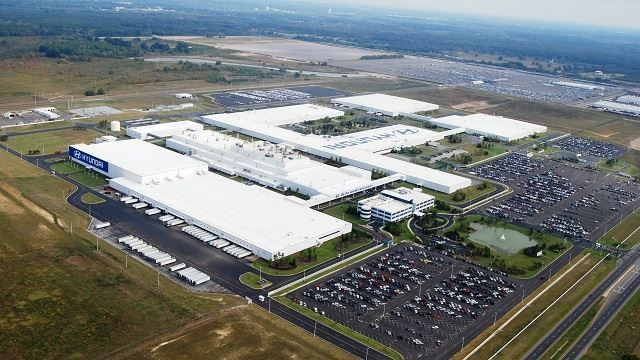
Hyundai Motor's Alabama factory in the United States / Courtesy of Hyundai Motor
By Baek Byung-yeul
The rapid spread of the COVID-19 in Europe, North America and other parts of the world has forced Hyundai Motor Group to halt operations at its manufacturing plants, amplifying the challenges the country's largest automaker is already facing, data showed Friday.
Both Hyundai Motor and Kia Motors have halted operations of their overseas plants as they have been following precautionary measures imposed by governments to help limit the further spread of the coronavirus pandemic. Also, a paralyzed global supply chain for auto components has also contributed to the halt in operations.
Hyundai is still operating its domestic factories but among its 12 global production bases, every factory excluding facilities in China have suspended operations. Hyundai's sister company Kia has also suspended operations at its plants in the U.S., Slovakia and India.
The suspensions amid a decreased demand for cars have made Hyundai and Kia's performance appear worse than they are.
According to the group, Hyundai Motor's car sales in the United States in March decreased by 42 percent to 36,000 compared with the same period in 2019, while Kia's sales decreased by 19 percent to 45,000.
After an employee working in its Alabama factory contracted the coronavirus March 18, Hyundai suspended the operation of the facility until April 10. Due to the suspension, Kia's Georgia factory, which sources engines from the Hyundai facility, also suspended production for two weeks from March 30 to April 10. The Georgia factory manufactures the full-size Telluride SUV.
In Europe, Hyundai ceased operation of its Czech factory from March 23 to April 9 while Kia's Slovakia factory was also closed until April 3.
The two carmakers were also hit hard in India. According to data from the Society of Indian Automobile Manufacturers, Hyundai sold 32,279 cars last month, a 47 percent decrease month-on-month. Kia's car sales in March fell by 52.3 percent to 7,466 compared with the previous month.
In regard to the difficult situation the group is facing, S&P Global Ratings placed Hyundai Motor Group on its watch list of firms with a negative outlook, citing that the auto giant will experience a 10 percent to 20 percent decrease in car sales in its major markets including North America and Europe.
“The COVID-19 pandemic is causing production suspensions and weakening demand in the global auto industry, which was already facing slowing demand in 2019,” the credit ratings issuer said.
“We expect Hyundai Motor and Kia Motors' 2020 sales volume to decline by about 15 percent in the U.S., about 20 percent in Europe, 5 percent in Korea and over 10 percent in China, on top of falls in emerging markets. Based on our revised forecast, we assume HMC-Kia's revenues will decline by 8 percent to 10 percent this year,” the report added.
The coronavirus crisis is not only a problem of Hyundai. It is also negatively affecting every carmaker in the world. According to the Korea Automobile Manufacturers Association (KAMA), 18 automakers have shut down 88 factories globally.
Lee Hang-ku, a senior researcher at KAMA, said the factory shut down by carmakers was “unprecedented in the 130-year-long history of the automobile industry,” adding “even during World War II, carmakers operated their factories to produce military supplies.”